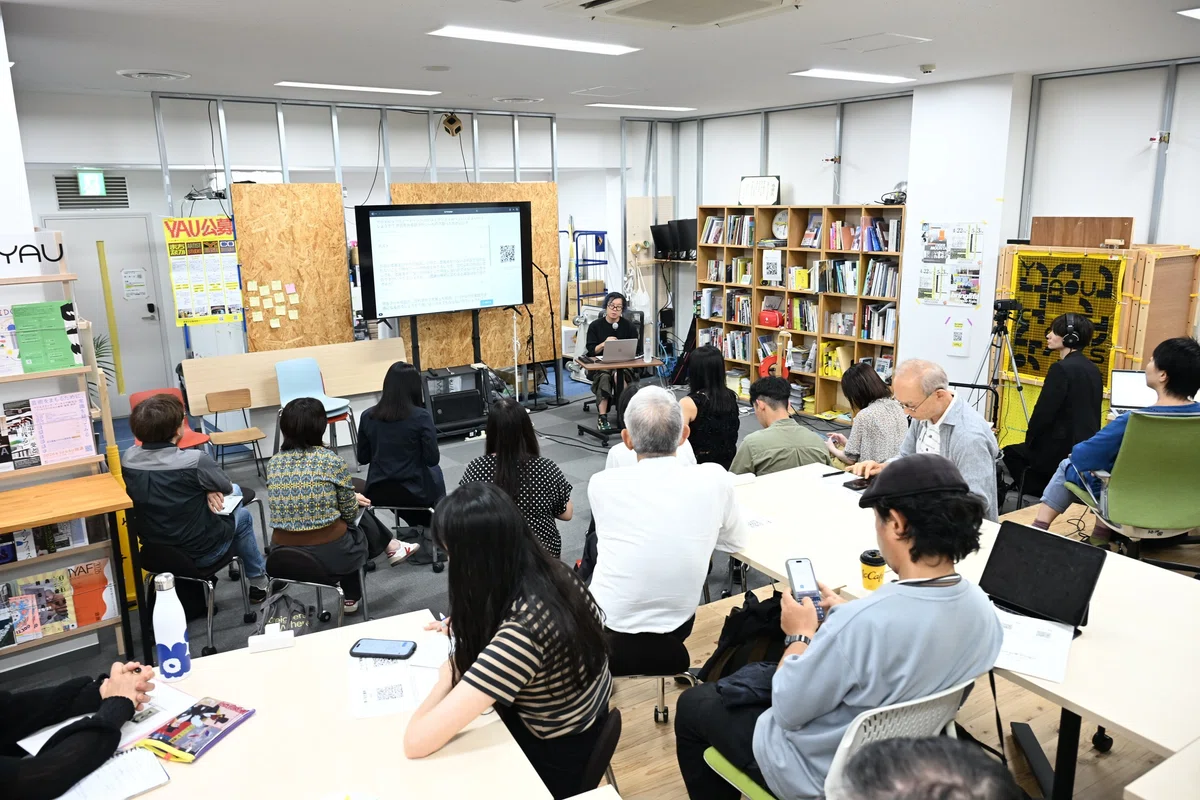
As a course that captures “art” not just as a way of engaging through “creating” or “viewing,” but as an existence rooted in daily life, the “Course Connecting Art and Society” began last fiscal year. This year, together with the same lecturers as before, it will develop into three courses that touch upon those connections more deeply and broadly.
In this article, we welcome contemporary art historian and cultural researcher Hiroki Yamamoto as a lecturer, and I, Fujimura from the management team, will deliver a digest of the first lecture of “Thinking about Art and Society from Contemporary Art History and the Present”, which began in September 2026. The theme of the first session is
“What is Contemporary Art?”.
[Hiroki Yamamoto] Born in Chiba Prefecture in 1986. Associate Professor, Department of Aesthetics and Art History, Faculty of Letters, Jissen Women’s University. After graduating from the Faculty of Sociology at Hitotsubashi University, he obtained his Master’s and PhD from the University of the Arts London. His books include “Contemporary Art History” (Chuko Shinsho), “Art in the Post-Anthropocene” (Bijutsu Shuppan-Sha), “The Art of This Country (Modern Japan)” (Getsuyosha), and “What is a Regional Art Festival?” (Heibonsha Shinsho). He translated Justin Jesty’s “Art and Engagement in Early Postwar Japan” (Suiseisha). He served as a curator for the Japan Pavilion at the “Gwangju Biennale 2024.”
Text = Kaeko Fujimura (YAU LEARNING)
Photo = Ami Takada (YAU LEARNING)
It didn’t start with “I like art and am researching art that is concerned with social issues”
The lecture began with Mr. Yamamoto’s self-introduction. He spoke about how he studied sociology before art, how he encountered a certain work and was shocked to find “there are works that are so incomprehensible,” which sparked his interest in art, and how he resonated with an approach that captures social issues not through statistics or data, but through human subjectivity and perception (social constructionism).

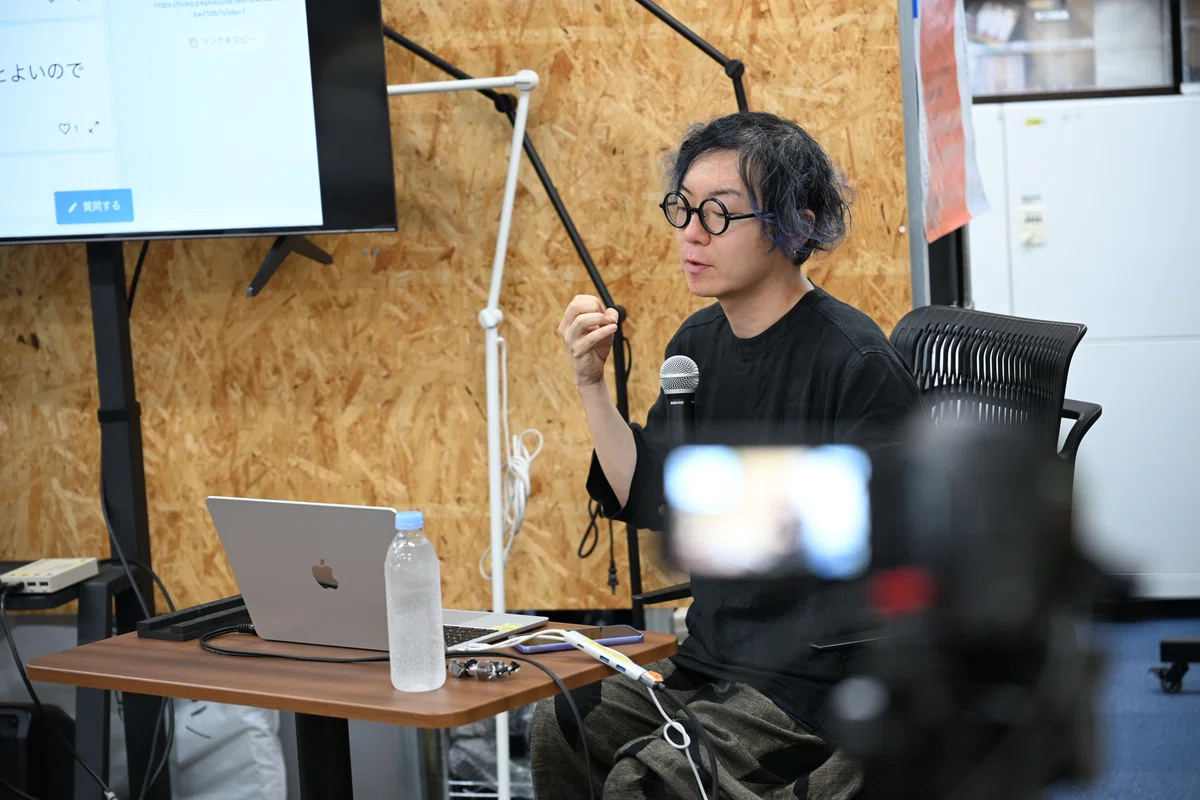
The story of how Mr. Yamamoto’s connection with art began, in a way that resonates with the “society” part of this course’s title, might also reach those who are unsure how to measure their distance from art. “Art” as something that pleases the eye, and “art” that has significance as a [tool] for discovering or solving problems. The multifaceted face of art has already begun to peek through.
What does “The definition is that it cannot be defined…” mean?
“The definition of contemporary art is that it cannot be defined”—the main session started with words that sounded like a Zen riddle. The words of Arthur C. Danto, an American art critic and philosopher, that “contemporary art is about redrawing the boundaries between what is art and what is not,” were cited, and a guide for how to perceive contemporary art was presented by Mr. Yamamoto.
The lecture proceeded while touching on specific works. As practical examples of questioning the definition of art and redrawing boundaries, he introduced “Hot Balls” (1992), a work created by American sculptor Tom Friedman by collecting superballs he stole from a store, and “Comedian” (2019), a work by Italian artist Maurizio Cattelan, in which a raw banana was taped to a wall.
“Just lined up?” “Just taped?” “A toy?” “A banana?” “He didn’t make it himself…?” Just like the people who encountered these works, the question “What is art?” echoes in our heads as we listen to the lecture.
“Modern Art” that views art as art, “Contemporary Art” that keeps questioning art
From the flow so far, Mr. Yamamoto cited “the activity of continuing to ask what is myself = what is art?” as one characteristic of contemporary art. He then presented the perspective of “an antithesis to ‘art for art’s sake'”, another characteristic, and approached “what is contemporary art?” while comparing it with modern art.

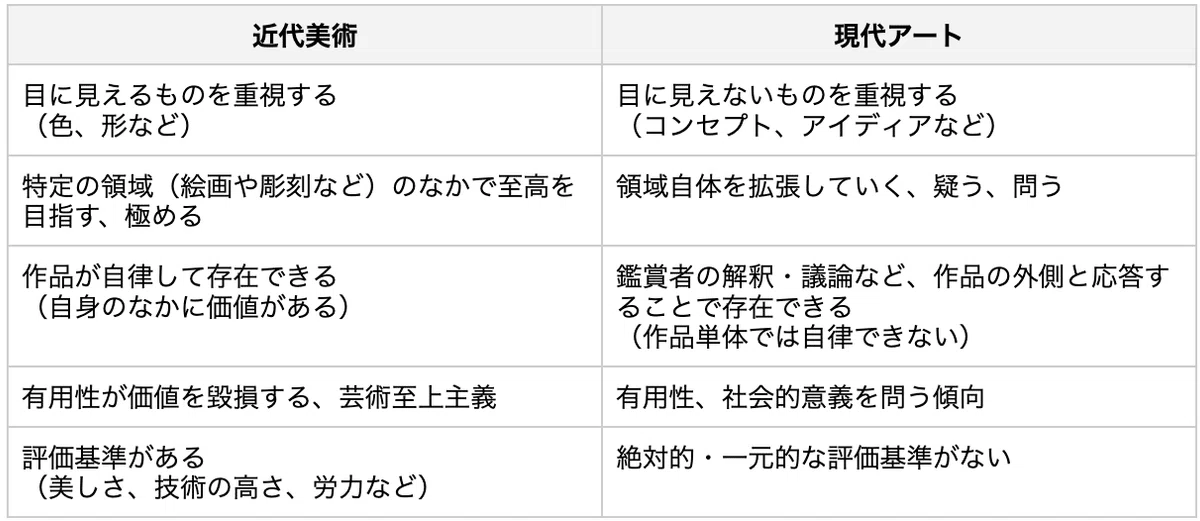
In the process of learning about each value system using the words “modern” and “contemporary” as clues, we realize that modern ways of seeing and contemporary ways of perceiving are alive within us who live in the present, and that the value system that “art is this kind of thing” was formed without us knowing. Some may have felt the moment when the era (= society) and I connected.
From the 60s to the 90s, how did contemporary art expand?
French artist Marcel Duchamp (1887-1968), said to have created the dawn of contemporary art, was introduced. He is an artist of the same era as Picasso and Matisse. His work “Fountain” is hailed as one of the works that had the most impact on today’s art. Even those who are not familiar with art may have heard the name, along with the work that is a signed men’s urinal.
In the second half, the history of various expression methods (minimalism, conceptual art, pop art, etc.) derived from the question “Is only what is visible to the eye art in the first place?” was introduced with overwhelming momentum, accompanied by Mr. Yamamoto’s passionate commentary.

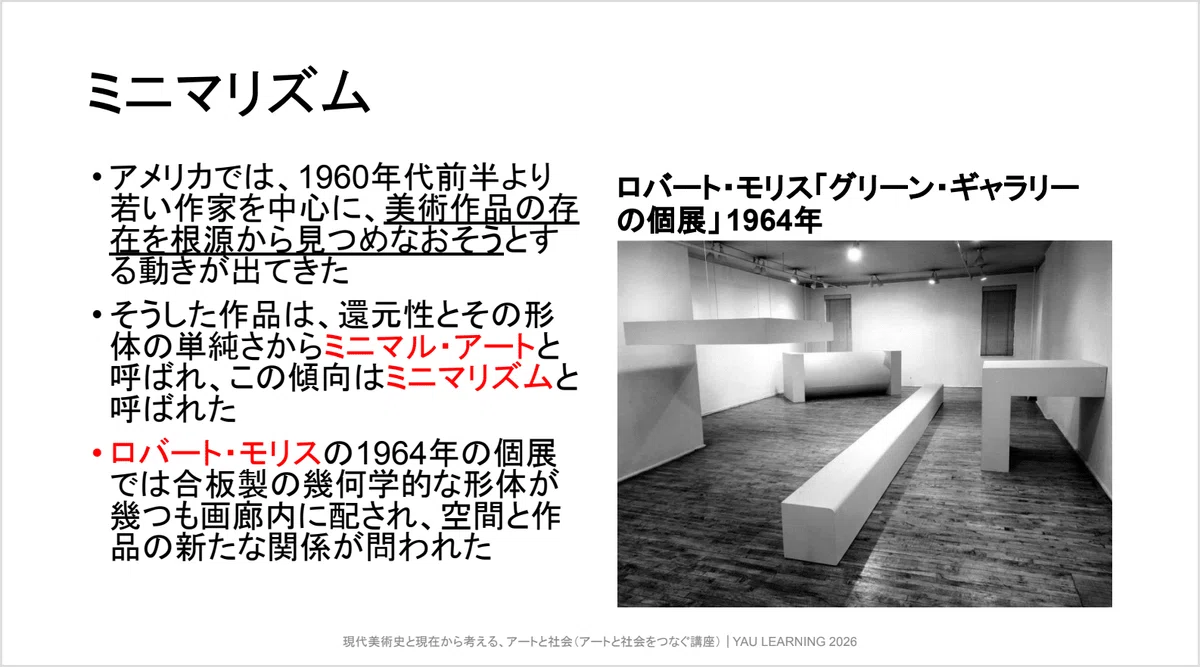
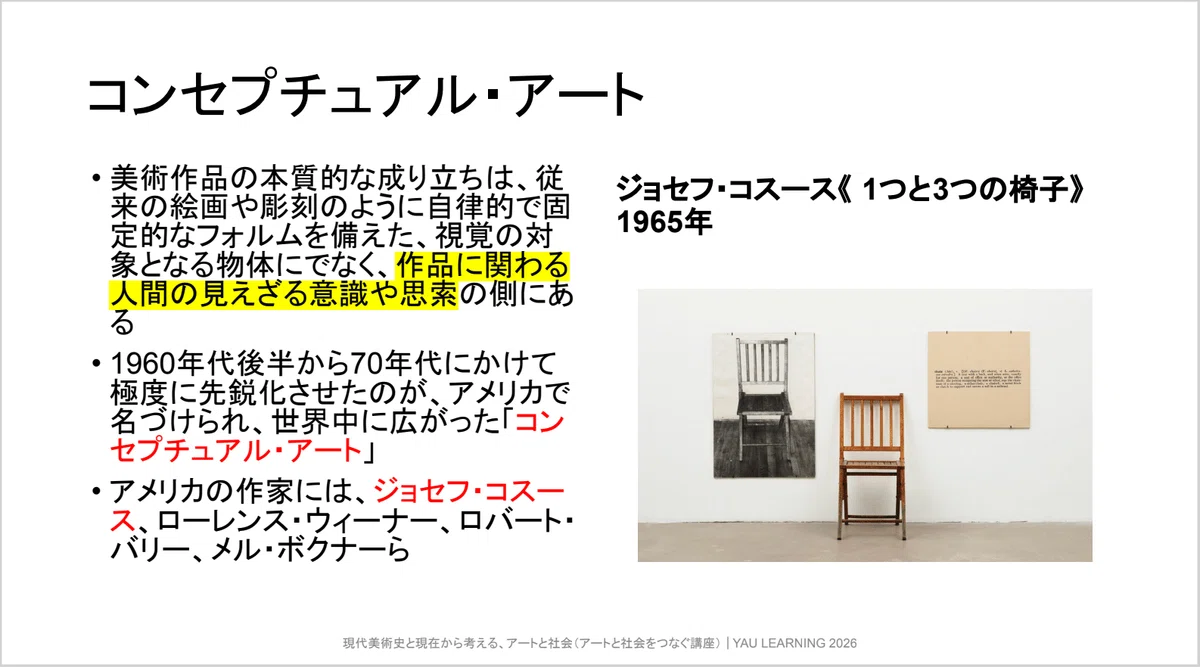
The way the definition of art is expanded was vividly explained through various questions such as ‘visible things (color and form) and invisible things (concepts and ideas)’, ‘what constitutes the completion of a work’, ‘the existence of the viewer’, ‘is art useful’?’, and ‘objects and space’. I highly recommend watching this in the video along with Mr. Yamamoto’s narration. (If you sign up for this course, you can watch all 6 lectures, including future sessions, in real-time and via archive videos. )
This course will be held once a month until next February with a changing theme. The next theme is ‘Art and Curation‘. I am very much looking forward to seeing how Mr. Yamamoto’s unique perspective on art and society will be portrayed.
Themes for future lectures
第2回:アートとキュレーション(10月6日)
—「キュレーション」とはどのような営みか、その歴史はどのように描くことができるのか

第3回:アートとジェンダー(11月17日)
—アート界のジェンダー不均衡はどのようにして生まれたのか、
その課題にアーティストはどう対応してきたか

第4回:アートとネイション(12月8日)
—国家とアートの交わりをどう描くことができるか、それはどのように変化しつつあるのか

第5回:アートと地方(2027年1月12日)
—「地域芸術祭」のブームをどう考えることができるのか、
アートにおける中央と地方の関係を批判的に問い直す

第6回:アートとエコロジー(2027年2月9日)
—インターセクショナル(複合的)な視座から「アートとエコロジー」の関係を問い直す、
アートはエコロジーの問題にどうアプローチすることができるのか
You can apply for this course until the end of February 2027 [Applications accepted at any time]
Lectures that have already ended can also be viewed later via archive videos. ・Archive viewing deadline: March 31, 2027 *Can be viewed as many times as you like until the deadline ・All lecture materials (PDF) can be downloaded
👉️ Click here for applications and details
(Opens the Peatix page)