

I visited The National Museum of Modern Art, Tokyo.
The autumn 2026 exhibition is titled “Takehisa Yumeji: A Creator Who Shaped an Era.”
I had a strong impression of Takehisa Yumeji as a painter of beautiful women who symbolized Taisho Roman, but that has changed significantly this time.
Exhibition Overview
Takehisa Yumeji (1884–1934) was active from the end of the Meiji era to the beginning of the Showa era as a creator with many faces, including painter, poet, journalist, designer, and illustrator. He is known as a figure who symbolizes Taisho Roman due to the female figures called the “Yumeji-style” and his retro-modern designs.
His lyrical works, which depict the sentiment and nostalgia of youth, Edo atmosphere and exoticism, and a longing for urban sophistication, resonated with people through magazines, postcards, and exhibitions, taking the world by storm. In addition, his work leading the era—such as designing daily goods to color life, creating books and magazines for children, writing the lyrics for the popular song “Yoimachigusa,” and documenting the Great Kanto Earthquake—had a major influence on subsequent generations. Active in a wide range of genres, Yumeji can be called a pioneering creator who crossed the boundaries between art and media.
This exhibition approaches his diverse work by gathering approximately 500 pieces and materials from Yumeji collections nationwide, including “Kurofune-ya” (Black Ship House), which is famous as Yumeji’s masterpiece, as well as Japanese paintings, oil paintings, woodblock prints, sketches, a wide variety of designs, and scrapbooks. Please pay attention to Yumeji, a creator who captured the era, created trends, and was loved by people beyond the framework of “art.”
Exhibited Works
Kurofune-ya (Black Ship House)
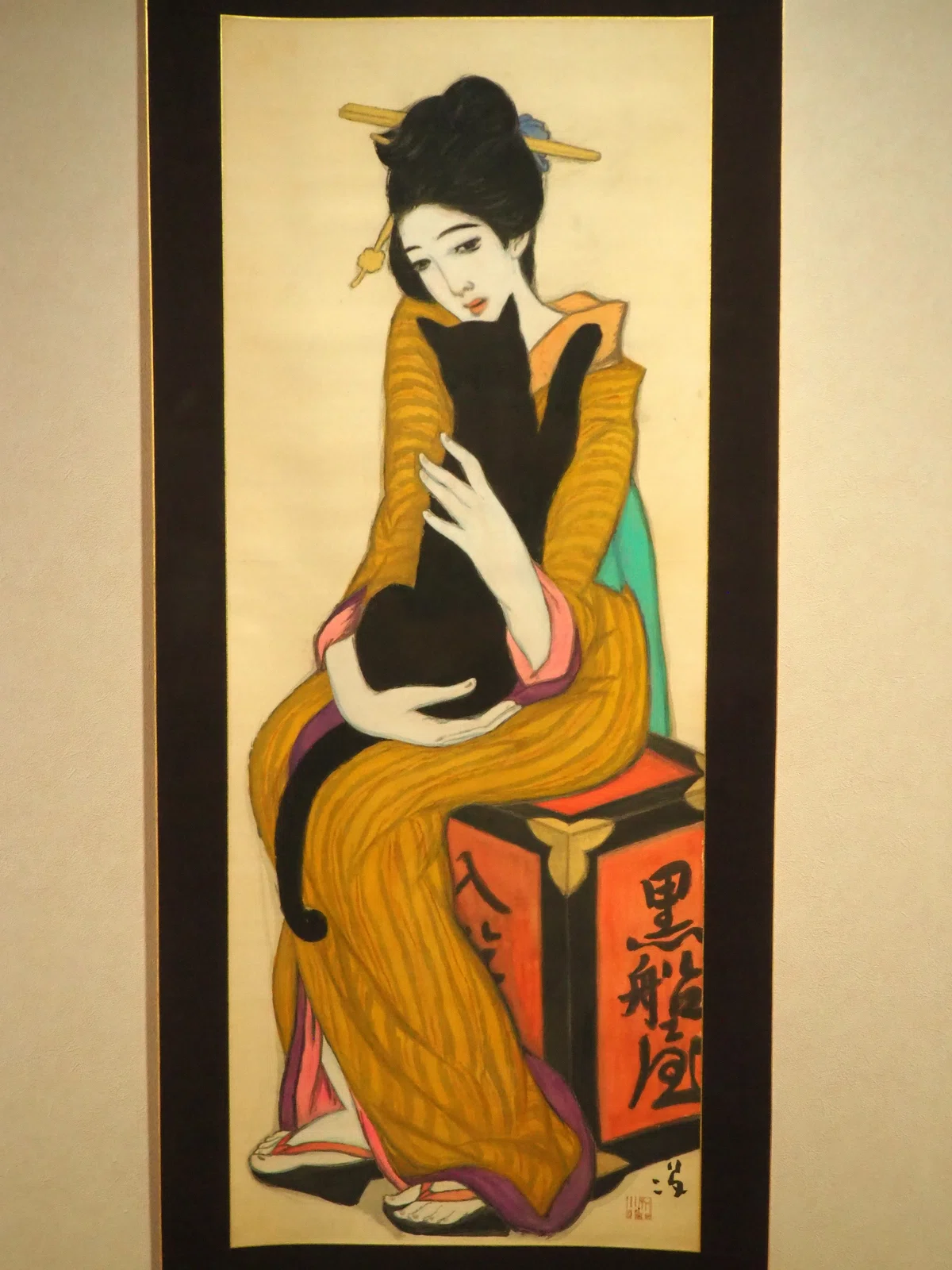
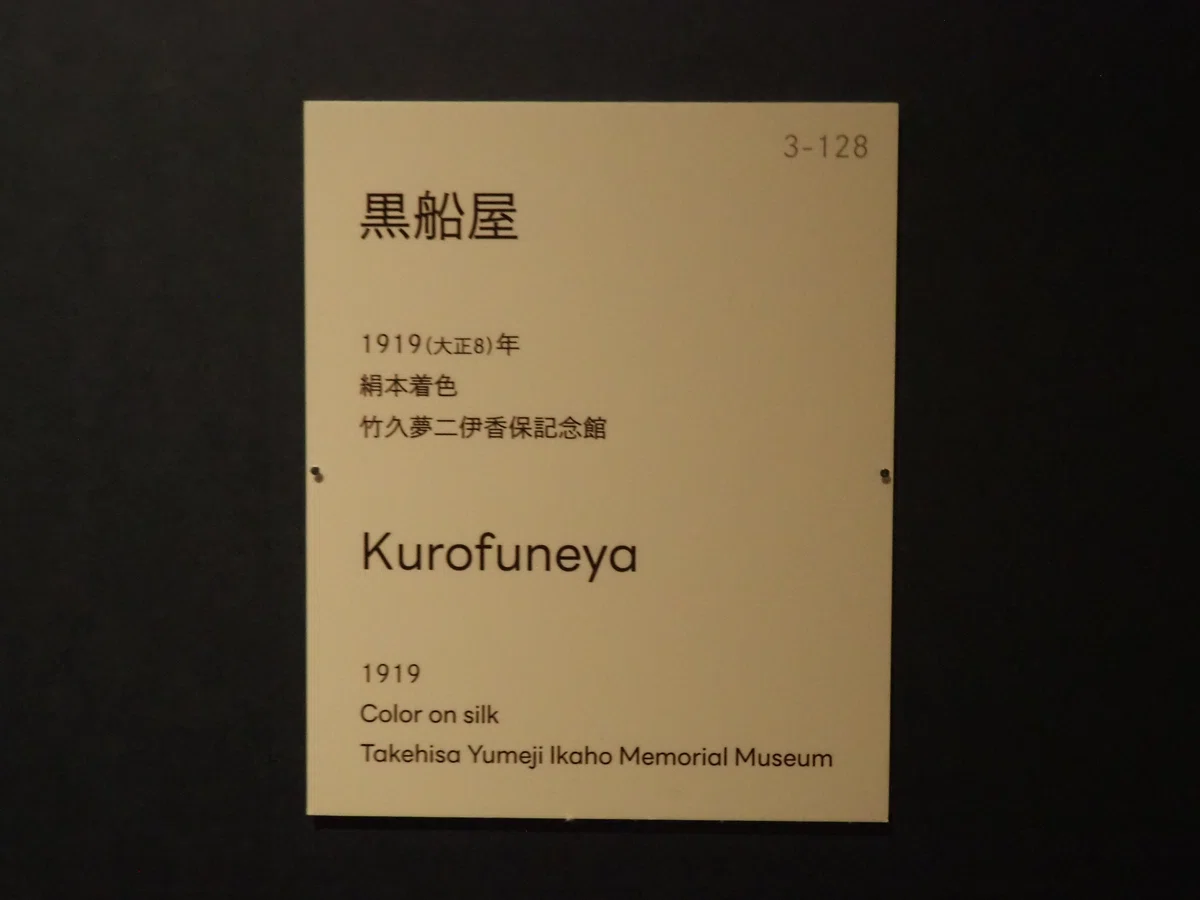
The work that left the strongest impression in this exhibition was, after all, “Kurofune-ya.”
This piece alone was displayed in an independent space, and when standing before the original, it had an overwhelming presence that set it apart from the other works.
A deep sorrow, as if something had been lost, drifted from the downcast expression and slender body of the woman. The black cat held in her arms felt as if it were gently snuggling up to her and comforting her.
While there is a fragility that seems as if it could disappear at any moment, there is a mysterious beauty that strongly draws the viewer in. I never tired of looking at it, and its presence was strongly burned into my memory.
Even now, some time after viewing it, I can vividly recall not only the work itself but also the space in which it was displayed. It was a piece that left such a deep impression.
Earthquake Sketch: Sunset in Ginza
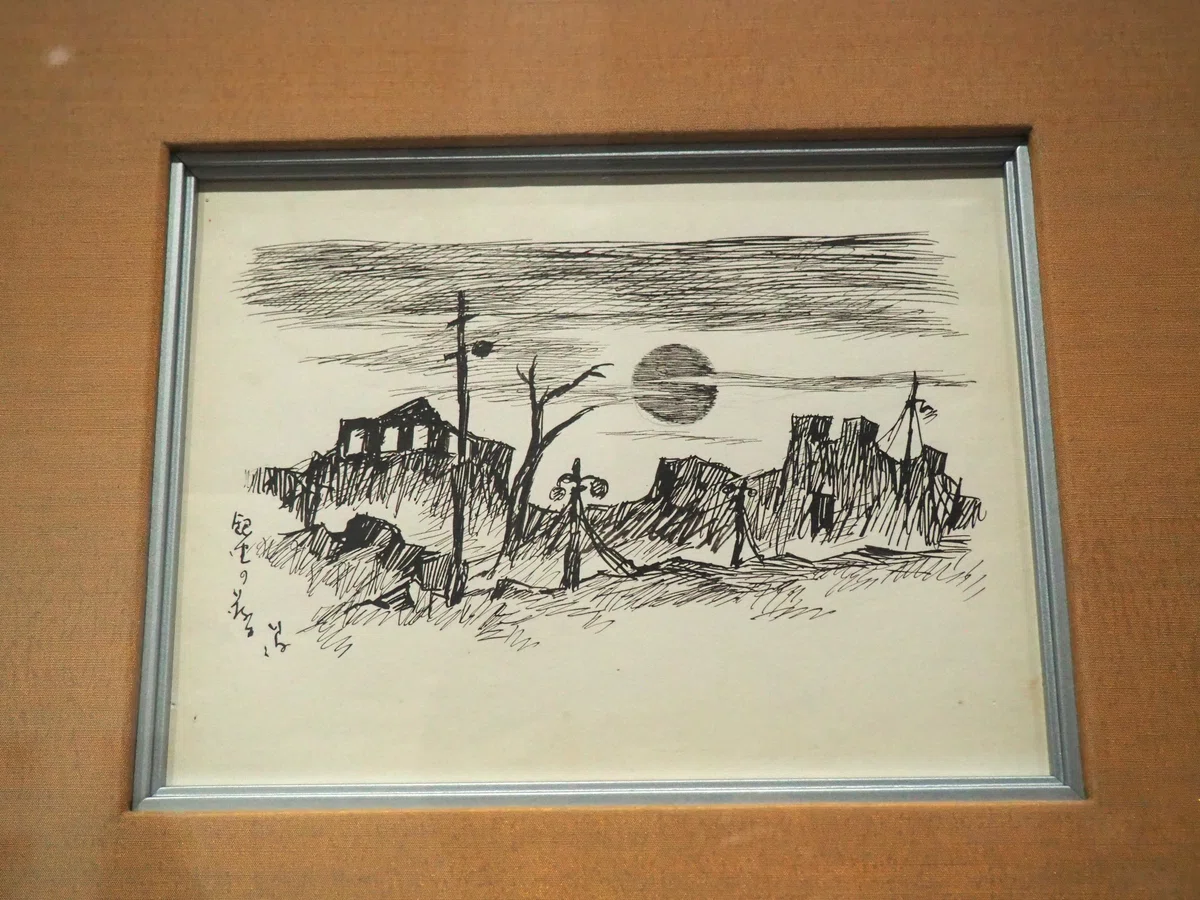
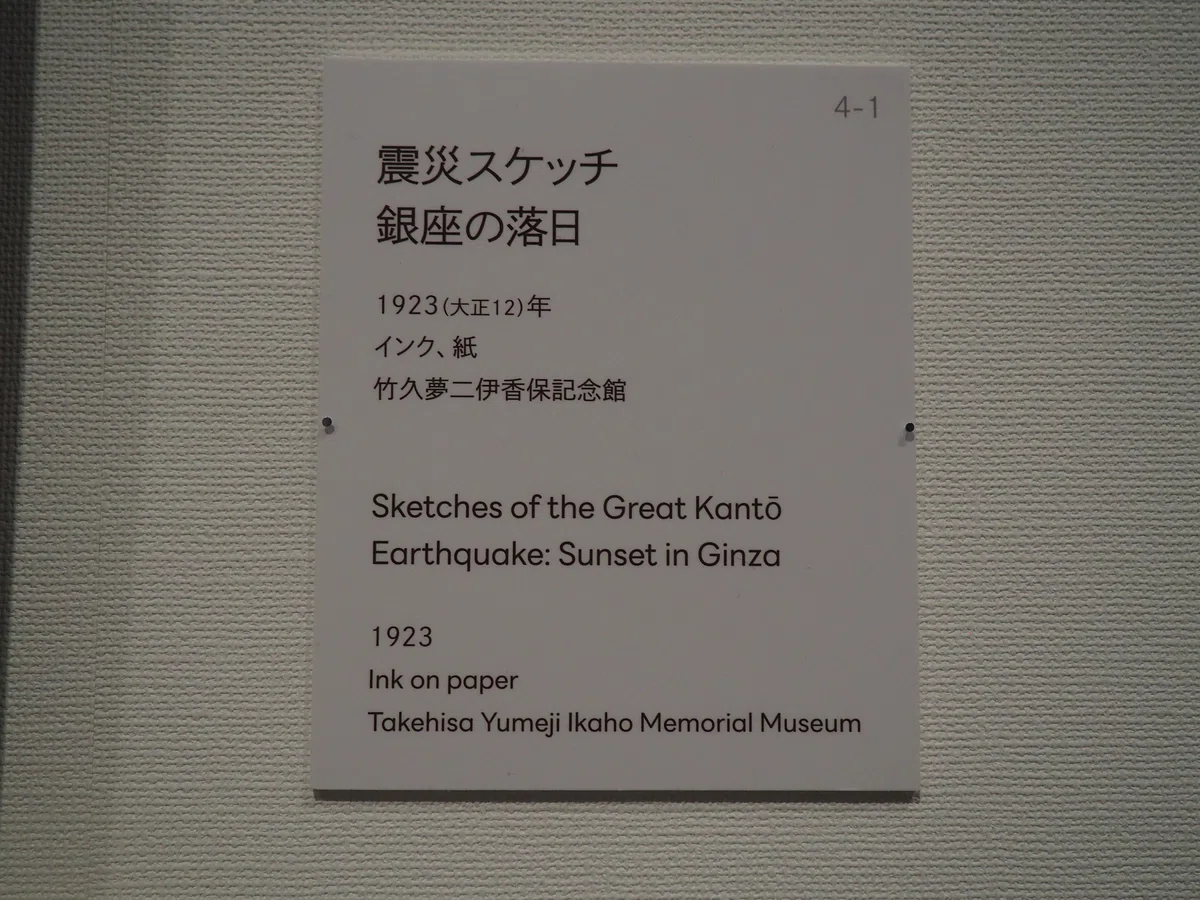
What shocked me most about “Sunset in Ginza” was the sight of Ginza, which had been completely transformed by the Great Kanto Earthquake.
It was such a scene of devastation that one would not know it was Ginza without the title, and I felt the terror of a natural disaster that could turn even a glamorous metropolis into a wasteland in an instant.
The sight overlaps with memories of modern earthquakes such as the Great Hanshin-Awaji Earthquake, the Niigata Chuetsu Earthquake, and the Great East Japan Earthquake.
In this work, I felt a greater significance in it being a sketch documenting the devastation of the earthquake than in its beauty as a painting.
Yumeji’s stance of trying to convey the reality before his eyes was impressive, and my conventional image of him as a painter of beautiful women changed significantly.
Although it is a work drawn over 100 years ago, it still appeals to us living in the modern day about the terror of disasters and the fragility of cities.
I felt that it is a work that goes beyond being a mere historical record and delivers a strong shock to viewers across the ages.
Minatoya E-zoshi-ten (Picture Book Store)
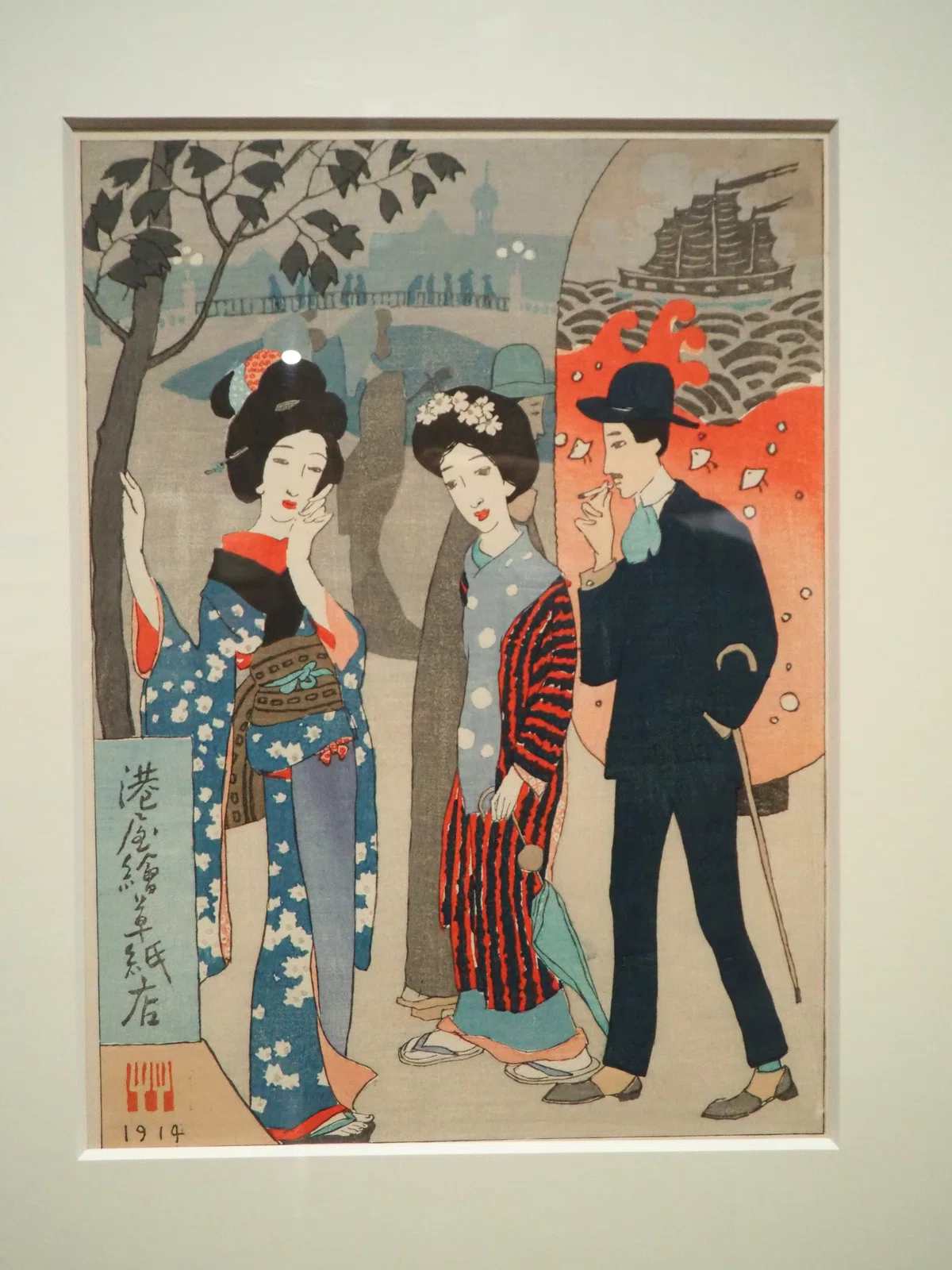
What left a particularly strong impression on me was the contrast between the women in kimono and the men in Western clothing.
Since I had mostly seen portraits of women in Yumeji’s works, the very fact that a man was depicted was surprising. The man stands on the right side of the frame, and he feels like a supporting character who highlights the women.
There is a somewhat distant sense of detachment between the figures, and it was also striking that I could not feel the melancholy or the joyful atmosphere found in works like ‘Kurofune-ya’ (The Black Ship House).
The figures’ postures and the composition as a whole seem to still retain traces of the Meiji era. It was a work that conveyed the atmosphere of the transition from the Meiji to the Taisho era through the coexistence of kimono and Western clothing.
Kamiji no Zu (Portrait of Kamiya Jihei and Courtesan Koharu)
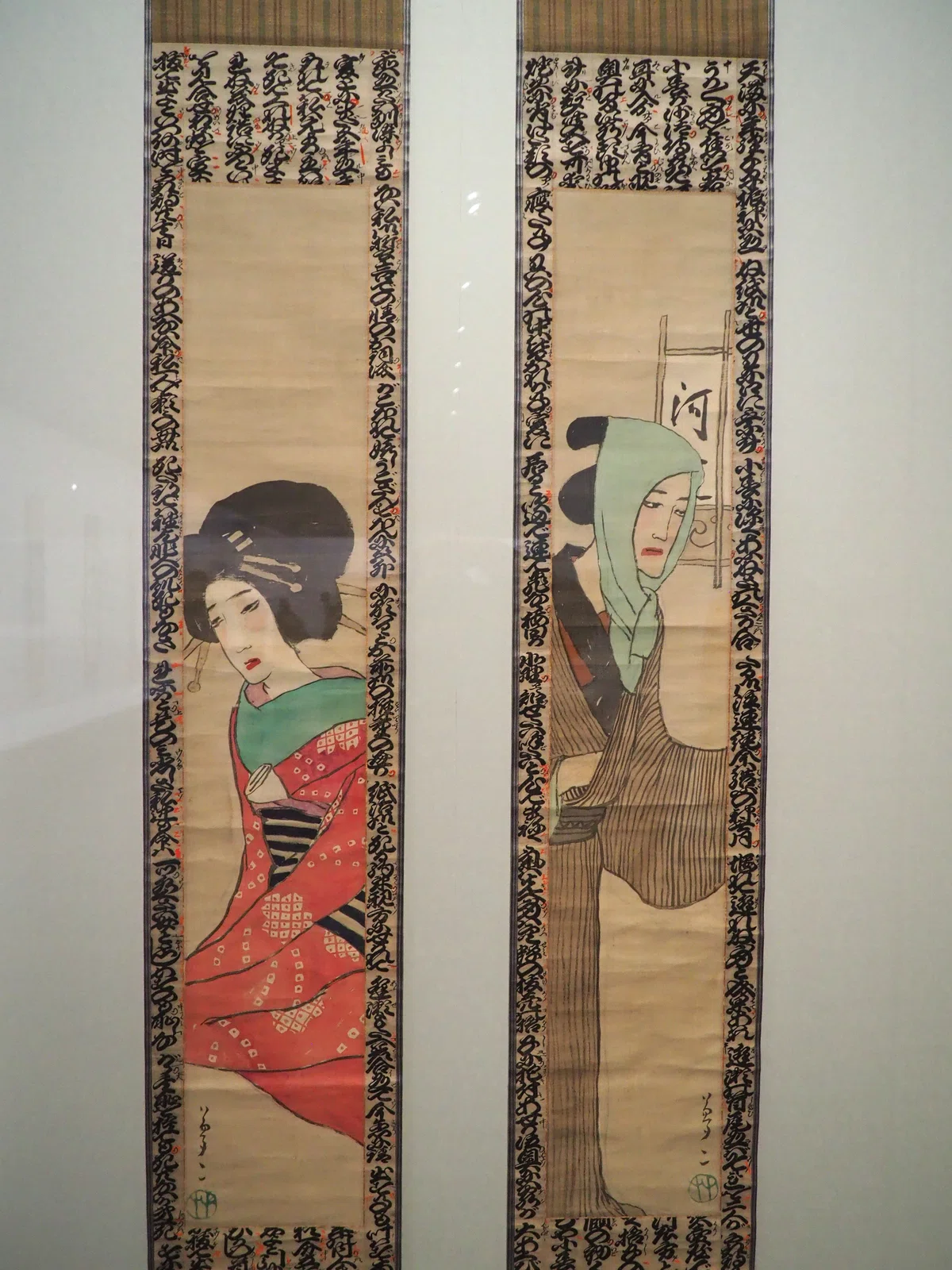
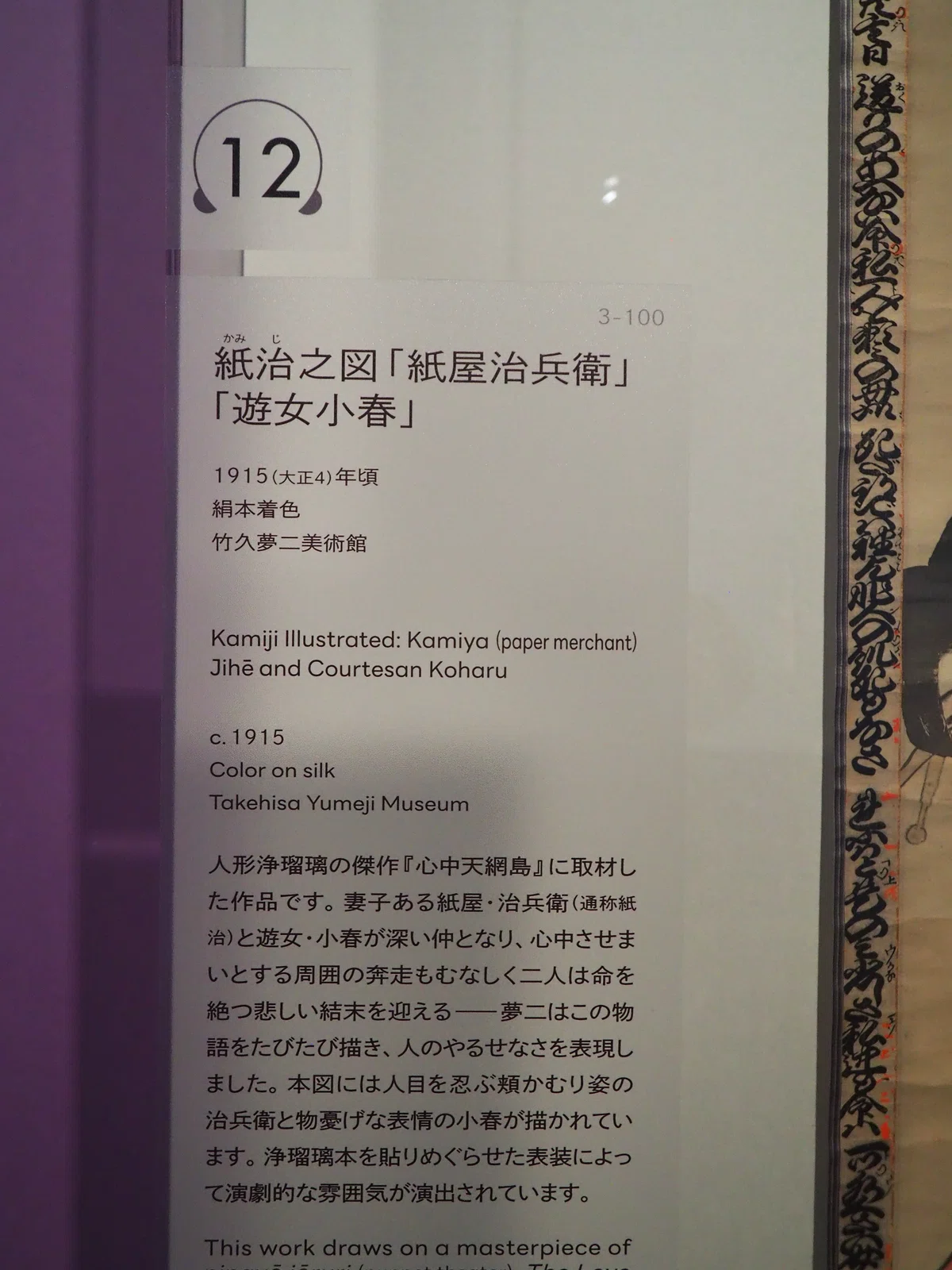
At first, I felt it was a bit strange that characters from the Bunraku play ‘Shinjū Ten no Amijima’ (The Love Suicides at Amijima) were depicted as a painting.
What was particularly impressive was the composition where Jihei and Koharu are facing in opposite directions. From that, the sadness of the two, who love each other but cannot be together, and who do not want to part but are forced to, was conveyed.
Yumeji makes the viewer feel the tragedy—which is expressed in Bunraku through narration, shamisen music, and the movements of the puppets—solely through a static composition.
Even if one does not know the story, I think the sadness is still conveyed. Once again, I was impressed by the high level of Yumeji’s expressive power.
Tatsuta-hime (Goddess of Autumn)
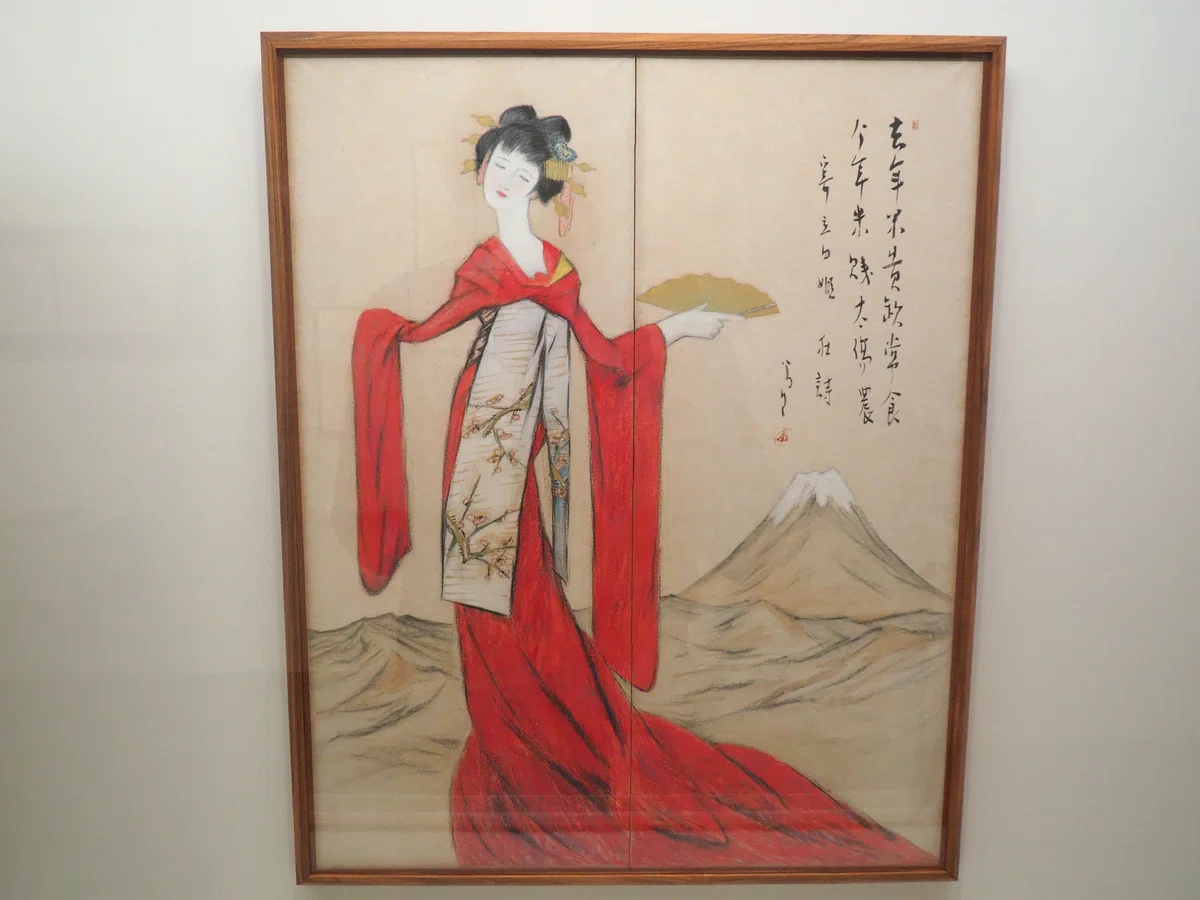
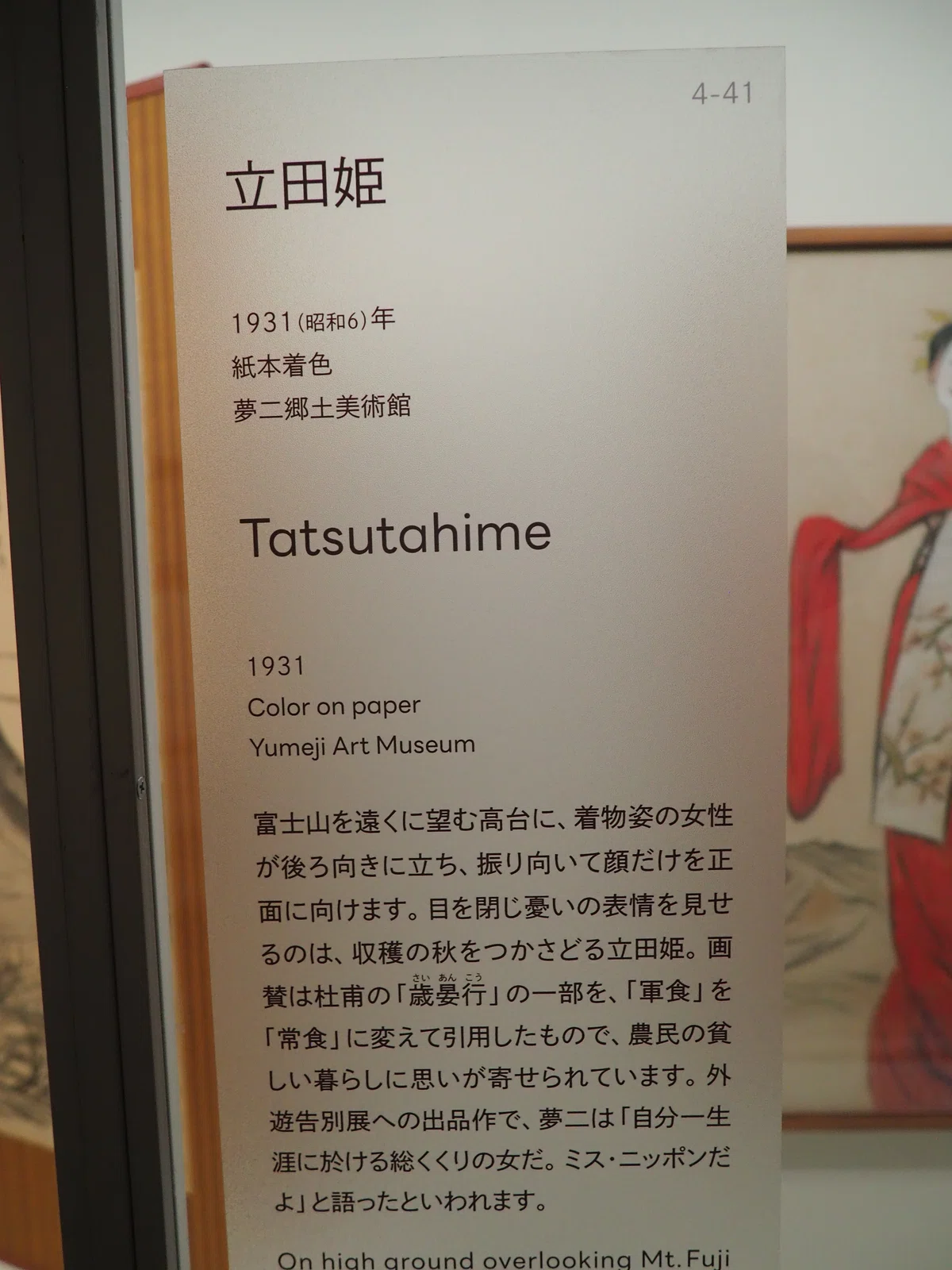
The woman in the red kimono left the strongest impression on me.
Because the background is almost entirely unified in muted tones, the woman in the red kimono appeared to stand out.
On the other hand, I also felt a sense of unease, such as the fact that Mount Fuji is not the familiar blue color and the unnatural angle of the woman’s neck.
It is not that I found it beautiful, but it was a work that strangely caught my eye due to the contrast of colors and the unique composition.
Woman Playing the Shamisen
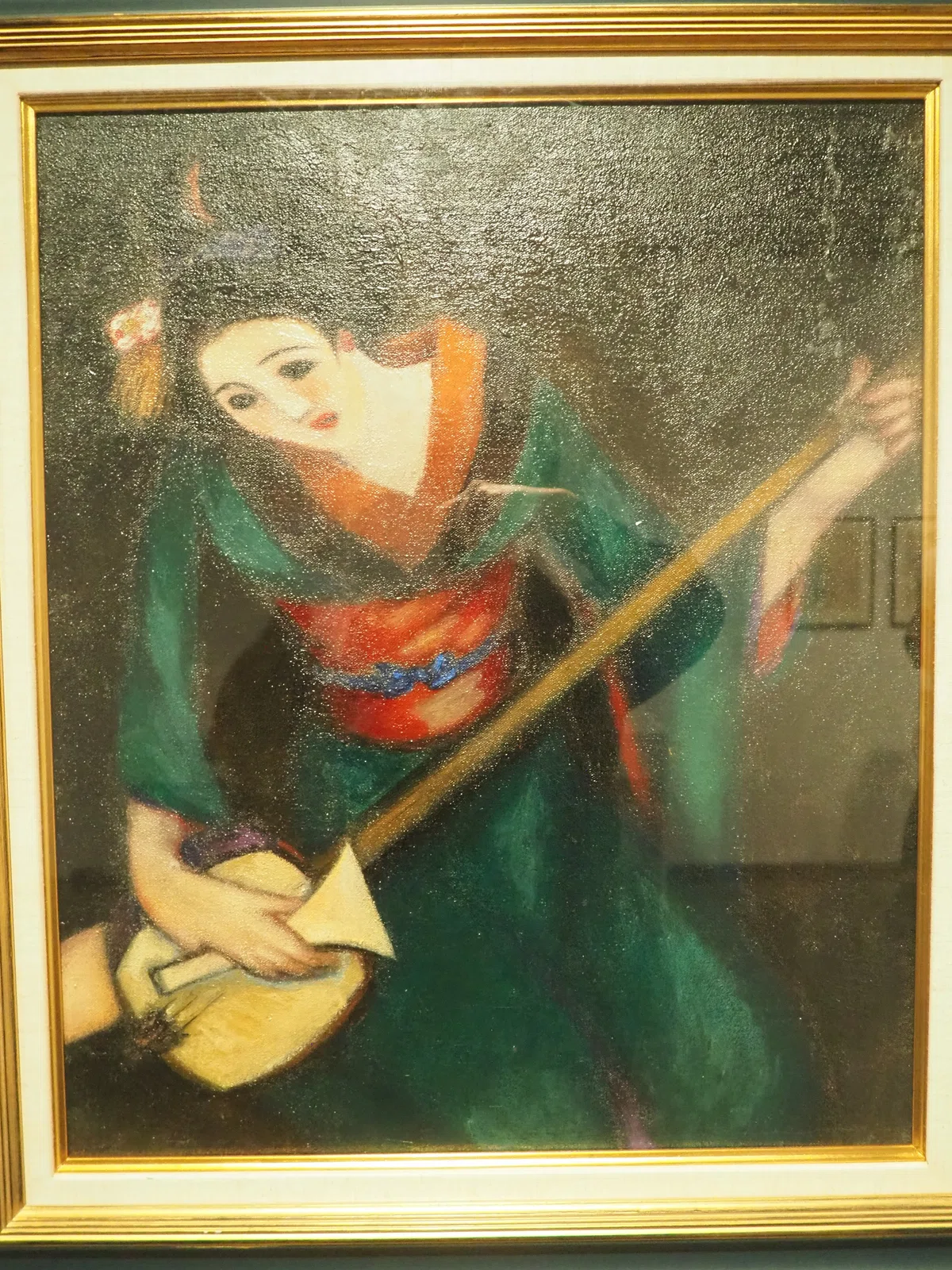
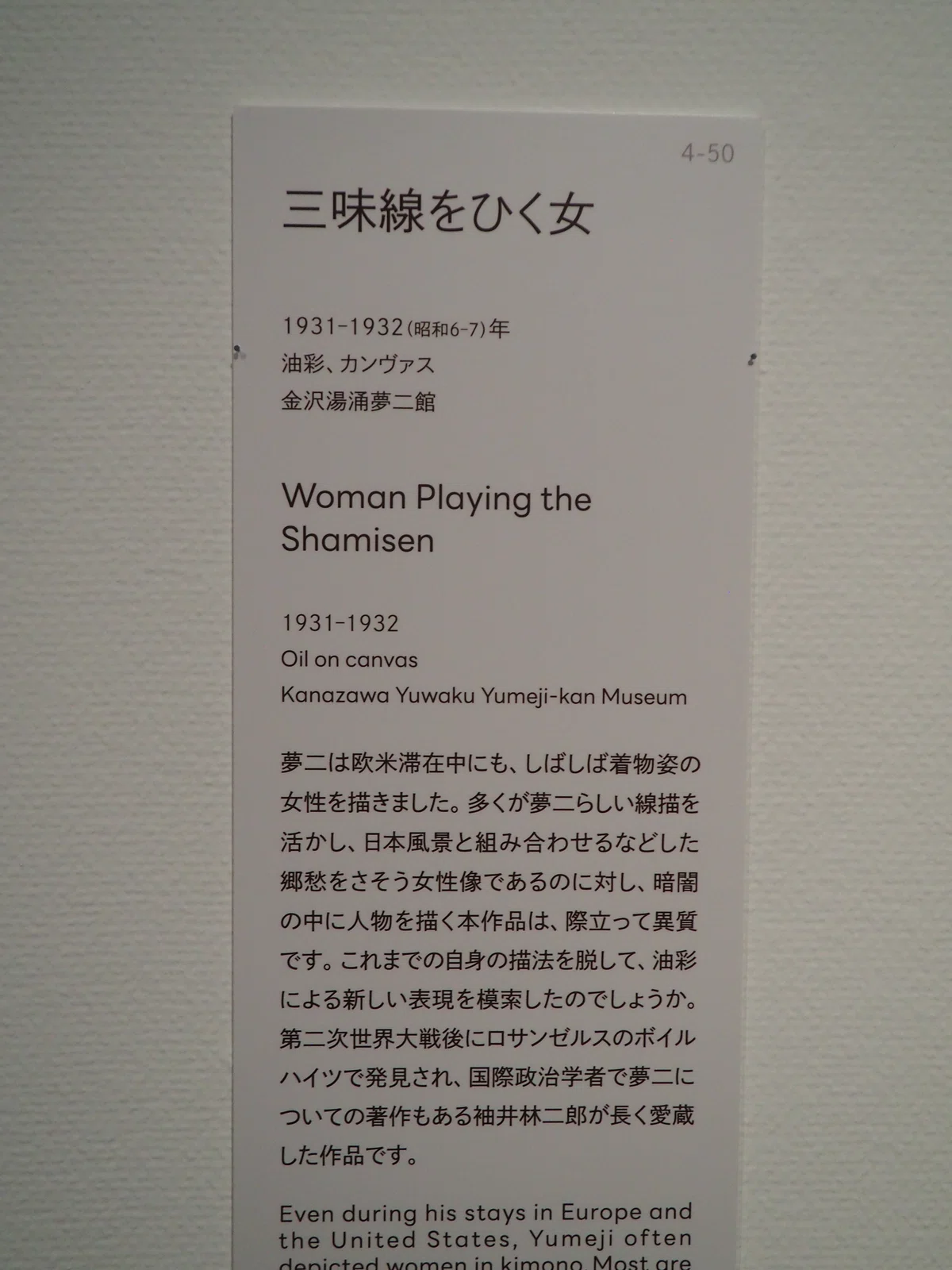
What left an impression on me was the fact that it is an oil painting, which is rare for Yumeji.
It has the depth of color and three-dimensionality unique to oil paintings, and I felt a beauty different from Yumeji’s usual works. On the other hand, the way the woman is depicted and her distinctive eyes still clearly show Yumeji’s signature style.
I was particularly drawn to the woman’s gaze.
While playing the shamisen, she seemed to be gazing vaguely into the distance, lost in thought and somewhat absent-minded.
There is an indescribable atmosphere to it, distinct from loneliness or calmness.
It was a beautiful and impressive work that allowed me to clearly feel Yumeji’s unique portrayal of women, even while using a technique different from his usual style.
Spring in Arashikyo
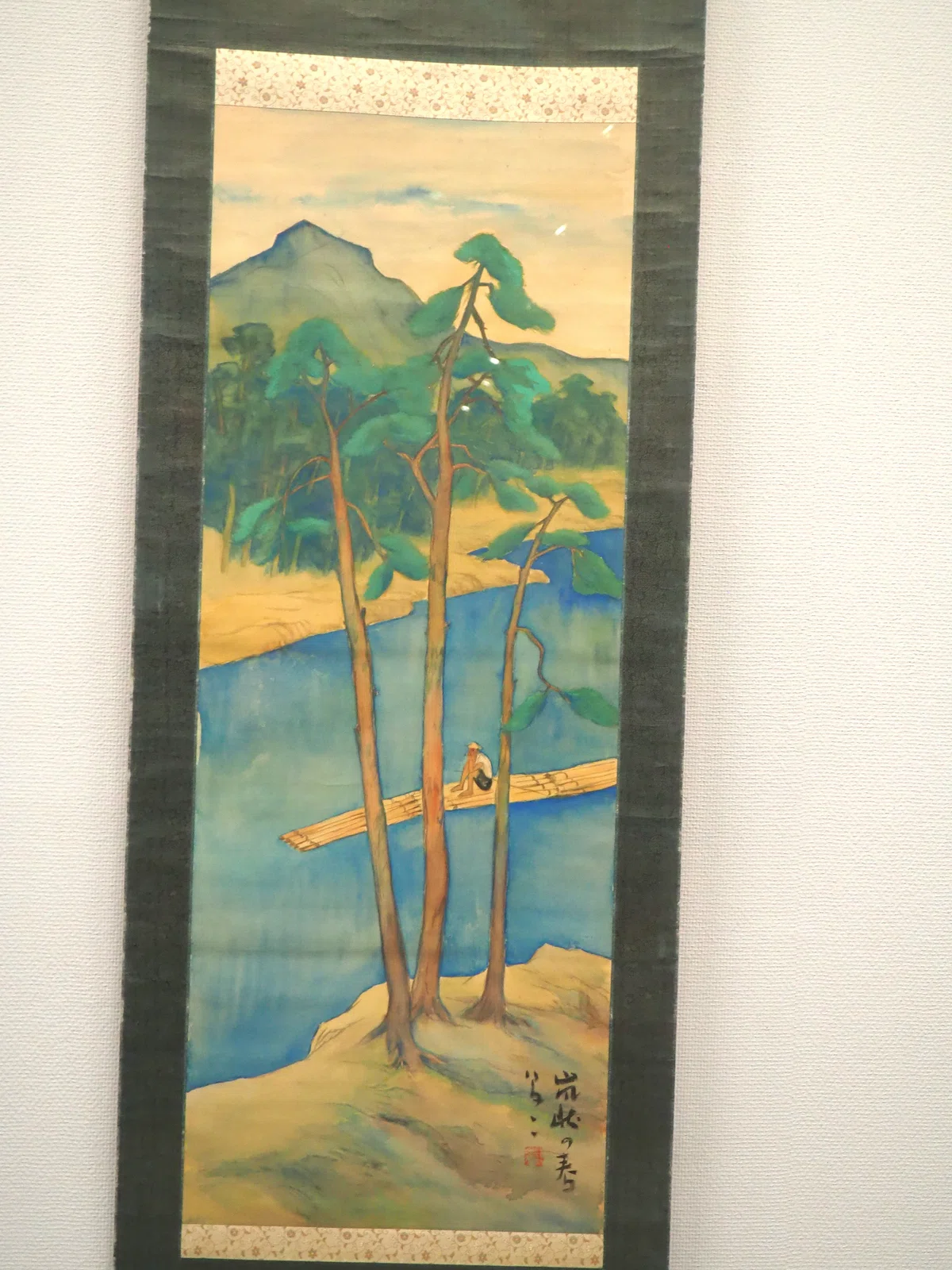
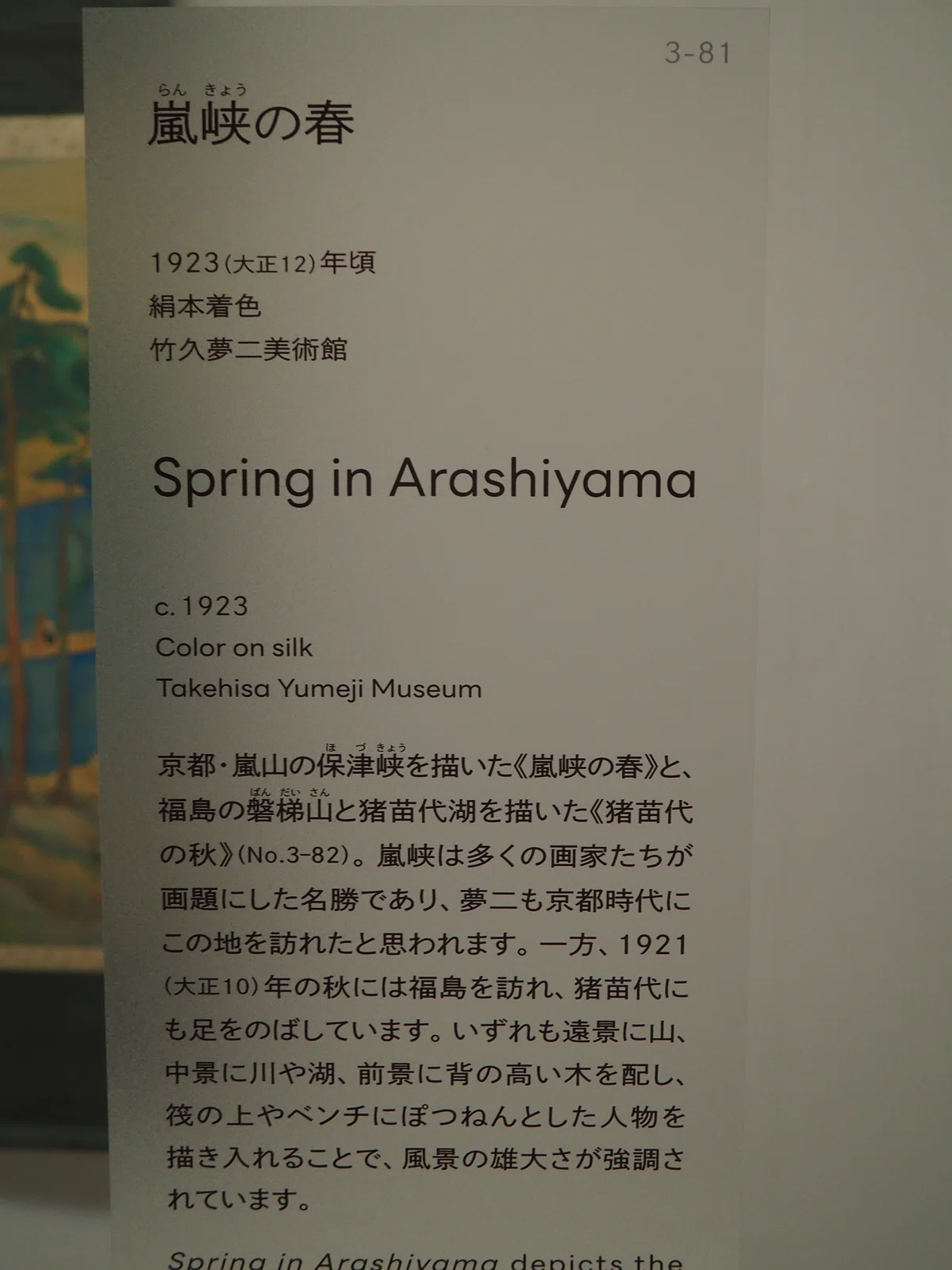
Since I had a strong impression of Yumeji as being known for his unique portraits of beautiful women, the fact that he painted landscapes was a surprise in itself.
In ‘Spring in Arashikyo,’ the scenery of the mountains and river is depicted realistically and dispassionately, making it feel as if I am looking at the work of a different painter.
More than the beauty of the landscape itself, I was surprised by the painting style, which is different from Yumeji’s usual work.
Learning about the breadth of his expression—that he could paint not only portraits of beautiful women but also realistic landscapes—has changed my assessment of Yumeji as an artist for the better.
