

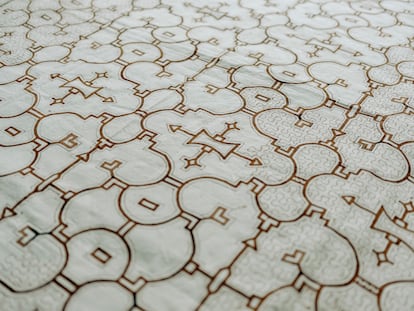
Everywhere you look in Pucallpa, in the Peruvian Amazon, there are geometric patterns that resemble fractals or expanding labyrinths. They are on the walls of houses, on shop signs, on posts and pillars, in the city center, and also on the roads. These are the kené, the ancestral designs of the Shipibo-Conibo people, who live along the Ucayali River, a tributary of the Amazon.
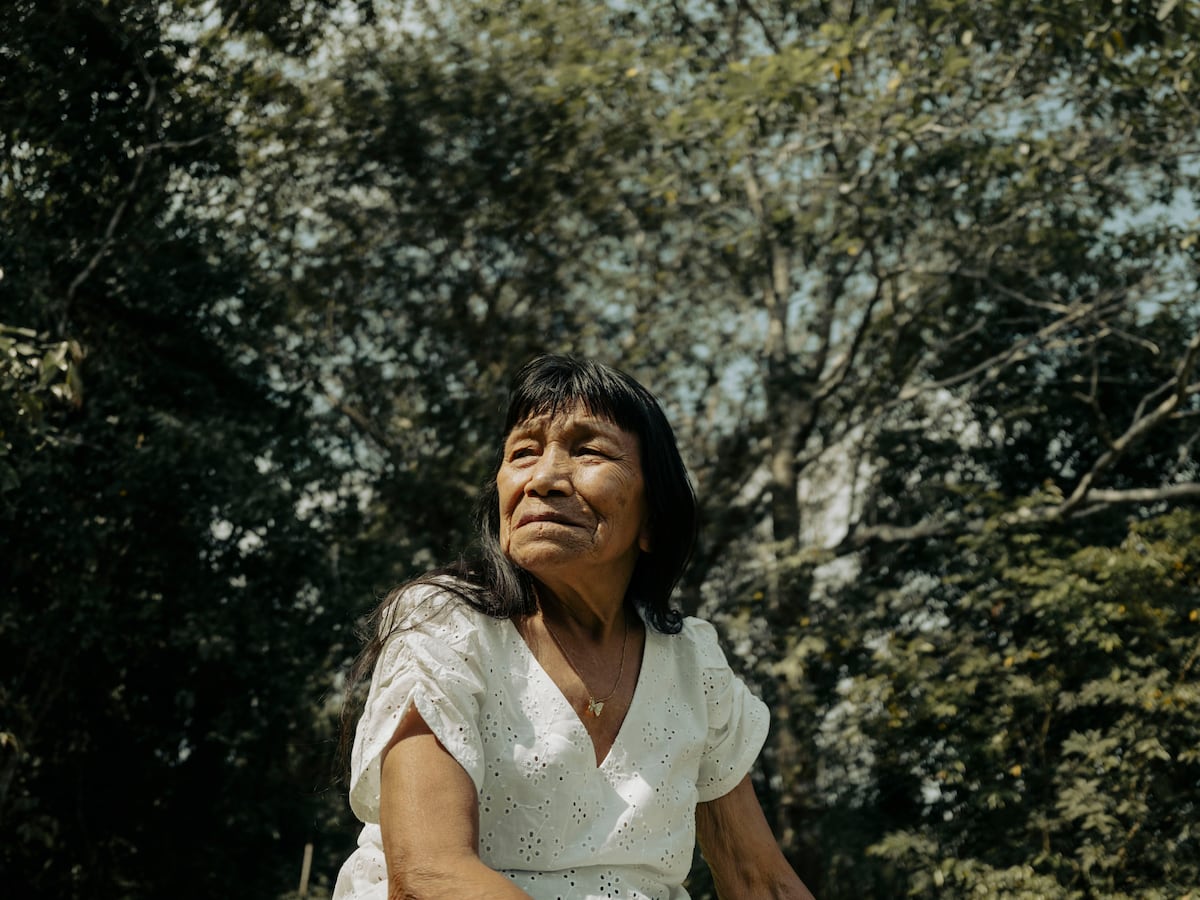
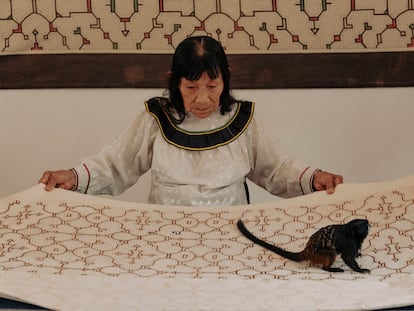
The kené has existed for centuries. For a long time, it was known as a type of craft — on textiles, ceramics, or jewelry — but today it occupies a different place. “It is craft, but it is also art,” says Sara Flores, 76, while drawing in her studio. “Crafts because of what has already been done, and art because of what we create from it.”
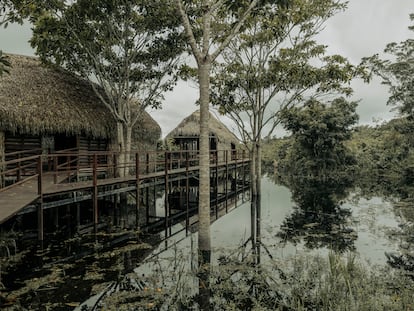
Although she lives in Pucallpa, she has a studio several miles away, deep in the jungle, within the Bakish Mai Multiverse (Land of Tomorrow), the educational institution she founded in what was once a retreat for ayahuasca, the hallucinogen of the Amazon. Kené and ayahuasca are linked: the patterns of the former come from the visions induced by the latter. But the connection goes further, since both are part of the Shipibo worldview, their way of understanding the world, and their healing practices.
According to tradition, the designs of kené come from Ronin, the primordial anaconda, creator of life and the universe. Bakish means both “yesterday” and “tomorrow,” and it is no coincidence that the Shipibo use the same term for both temporalities. “Whoever takes ayahuasca sees the art in their mind,” says Flores. “And the art represents our way of life in the jungle.”
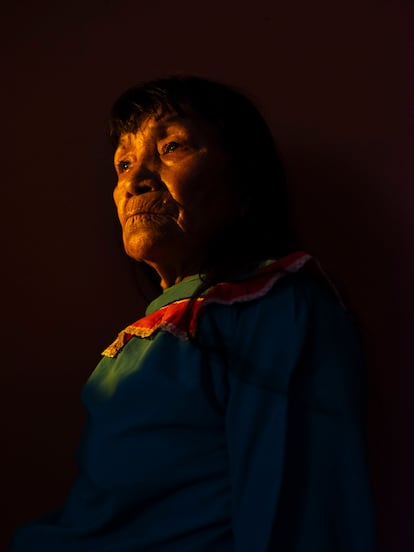
In May, this way of life will arrive at the Venice Biennale, the world’s largest contemporary art event. For the first time, Peru’s official pavilion will be represented by an Indigenous artist, Sara Flores. The decision by the Peruvian Cultural Foundation to select Flores adds to the growing international recognition of Amazonian art, through artists such as Chonon Bensho, Lastenia Canayo, Olinda Silvano, Santiago and Rember Yahuarcani, and Nereyda López. This year, the selection for the Biennale’s central exhibition — not organized around national pavilions — will include the Shipibo ceramicist Celia Vásquez Yui.
But Flores has reached a different status. Last year, she also became the first Indigenous artist to have a solo exhibition at the Lima Art Museum (MALI). Collections such as the Guggenheim and the Metropolitan Museum of Art in New York have acquired her work. And she is currently working with White Cube, which has already presented her work in exhibitions in Paris and London and plans to bring it to New York this summer.
Jay Jopling, the gallery’s founder, speaks enthusiastically about why he decided to add Flores to his exclusive roster of artists: “Sara continues to expand the possibilities of painting. Her work is prescient and profound; it speaks of the interconnectedness of everything and reminds us how humanity needs to remain respectful of our fragile place within the natural order of the world.”
On the other hand, her recent collaboration with Dior, which produced a limited edition of the Lady Dior handbag featuring one of her designs, sparked criticism in Peru, where some considered it a trivial commercialization of her artistic expression. However, Flores explains that she accepted the commission out of respect for the mastery of the French fashion house.
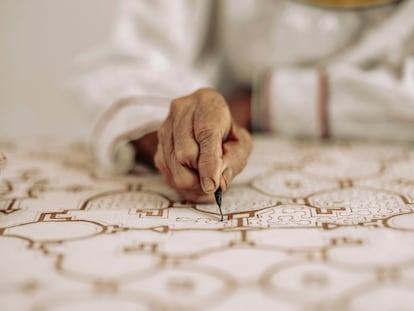
For her, kené requires two elements: menin, technical skill, and shinan, individual creativity. She applies these elements by painting patterns from her imagination onto the fabric — “like when you write a letter” — driven by a stubborn horror vacui that creates patterns within patterns.
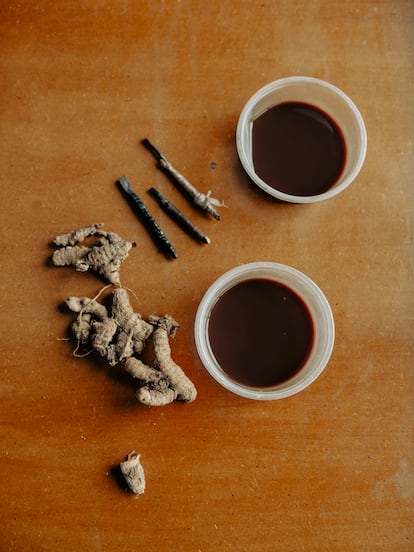
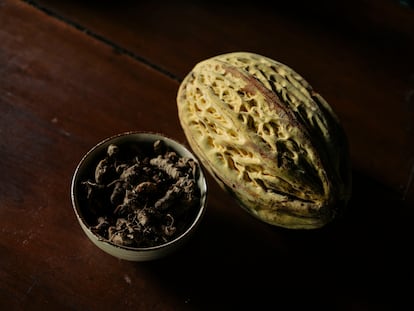
Her tools are simple: a sharpened umbrella rod used as a brush, natural pigments obtained from the surroundings— yacushapana bark for dark brown, turmeric for yellow, annatto for red, jungle leaves for green — and white river mud to fix the colors. The result sometimes evokes art brut, sometimes mandalas, sometimes generative digital structures.
The art of kené weaving is passed down matrilineally from mothers to daughters, and that’s how Sara learned it. “As a child, I was curious, and I would watch my mother painting her fabric. I would take a small piece and, little by little, I would paint too.”
Her mother and other friends would sell their fabrics at the nearby Amazonian Hospital, a medical center founded by the German Teodoro Binder, whose wife, Carmen Koch, loved local crafts. “The Shipibo mothers would take their fabrics to her, but she bought almost everything from my mother because she thought hers was better. By the time I was 15, I already knew how to paint, and I started taking my fabrics to Mrs. Carmen, and she would buy them. That encouraged me to continue.”
When Sara was selling her work for ridiculously low prices — sometimes just in exchange for used clothing — she befriended a foreigner named Carolina, who gave her advice: “She told me, ‘Look, Sara, your work is very beautiful, but you have to do two things. One is to sew the edge of the fabric so people think it’s finished, and the other is to add your signature, your initials.’ SFV: Sara Flores Valera.” Since then, all her work has included those three letters.
“Carolina” is the British anthropologist Carolyn Heath, who arrived in Pucallpa in 1973 to work at the Amazonian Hospital and ended up staying for a decade. Besides helping Sara create a craft cooperative with other Shipibo women, she had twin children with Julio, Sara’s husband (polygyny has not been uncommon in Shipibo-Conibo communities). One of them, Mayasuni, is married to Archduke Philipp of Habsburg-Lorraine. Their daughter, Amaya of Habsburg, participated in a 2018 Shipibo ritual in which she received the name Suysamenu, meaning “shining.”
Through Sara’s lineage, her daughters, Deysi and Pilar, and her granddaughters, Diana and Fiorella, continue the artistic tradition and share it in the workshop. “Shipibo girls should learn the kené, and another profession as well,” she says. “That way they will be professionals without abandoning our customs.”
It is no coincidence that this interview takes place in her studio, with her working at her canvases: this setting reinforces the idea of individual authorship, demanded by the global art market, as opposed to the communal authorship characteristic of Shipibo traditions.
But the truth is that the workshop (family-run or not) has been a typical form of production in Western art for centuries, without diminishing the authorship that the market seems to demand. Ultimately, this is not so different from the promotional strategy of Damien Hirst, who, when he created his cherry blossom paintings, made sure to be photographed in the middle of his work with his clothes stained with paint, despite being a conceptual artist with a large studio staff.
Filmmaker and curator Matteo Norzi, who, along with Issela Ccoyllo, is curating the Biennale pavilion, doesn’t shy away from the issue: “Obviously, collective knowledge is important in the Amerindian world, but it’s also true that we’re talking about a different context, where getting up every morning to create requires strong personal motivation. Collective knowledge shouldn’t be understood in a way that obscures individual authorship. That’s why it was a stroke of genius on Carolyn’s part to advise Sara to sign a work whose beauty and technical skill she is so proud of.”
Norzi, an Italian living in New York, arrived in Flores at the end of the last decade, tracing the signature of her creations. He had directed a film in the region, Icaros: A Vision (2016), about the ayahuasca experience, alongside Leonor Caraballo. His co-director, who died shortly after filming from cancer, was the one who put him on the trail of the woman who painted unusually beautiful canvases on which she left her initials.
Norzi, who defines himself as “Sara’s studio manager,” acted as a liaison between Flores and the White Cube. He also spearheaded the creation in New York of the Shipibo Conibo Center, whose objective is to support the community and prevent extractive practices. The income generated by Flores’ work is distributed equally between her, her family (with the commitment that, within the workshop, they continue to instruct the new generations in the kené), Indigenous organizations (such as the Shipibo-Konibo-Xetebo Council, which aspires to an autonomous territorial government under the principle of self-determination), and the dissemination of the culture and problems of the Shipibo-Conibo people.
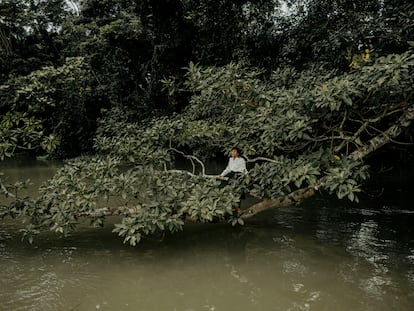
The context in which this art develops is marked by threats. Shipibo life depends on the Amazon rainforest, where deforestation is advancing, driven by illegal coca crops, mining, oil palm monoculture, and Mennonite agricultural colonies. Mennonites are a Christian group of Swiss origin with a strong presence in Latin America. Their practices involve the progressive elimination of the forest and the transformation of the ecosystem. “They enter our territory and create chakras [clearings in the jungle] of five or 10 hectares to plant rice and raise cattle,” Flores laments.
Both she and Norzi consider the emergence of kené in contemporary art circles important because it raises awareness about preserving the way of life that makes it possible. “Now there are people who didn’t know us and come from far away to see our work, and even I’m surprised at how important I am,” Flores says, laughing. “I still find it hard to believe I’m going to be in Venice. But the most important thing is that in the future, there will be a path for other artists, who will demonstrate that this is both tradition and creation. It’s our culture, and we must persevere in it.”
Sign up for our weekly newsletter to get more English-language news coverage from EL PAÍS USA Edition
