


This article was produced by National Geographic Traveller (UK).
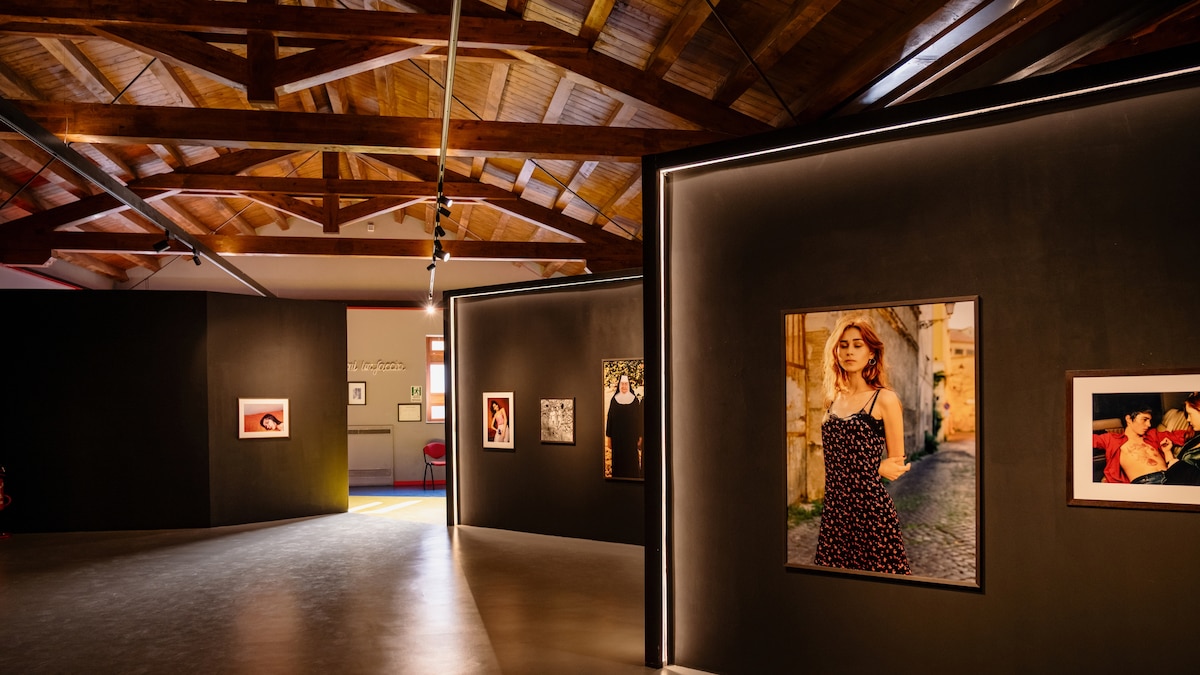
Inside a low-lit basement, three red neon signs glow against bare concrete walls. The first spells out the Italian word memoria (memory) in full. In the second, two letters have disappeared. By the third, only two remain visible, the rest swallowed by darkness. Artist Rossana Taormina watches as I study her latest installation, its light glinting off the gold earrings touching her shoulders. “Memory and landscape have always been a theme in my work,” she says. “My identity took shape here.”
I’m at the Belìce Epicentro della Memoria Viva in the town of Gibellina Nuova (New Gibellina), where Rossana is exhibiting her work as part of Italy’s first Capital of Contemporary Art programme. The museum tells the story of the earthquakes that tore through the Belìce Valley in western Sicily in 1968, killing more than 300 people and leaving tens of thousands homeless. Gibellina Vecchia (Old Gibellina), the town’s original iteration six miles uphill to the east, was one of several agricultural centres reduced to rubble.

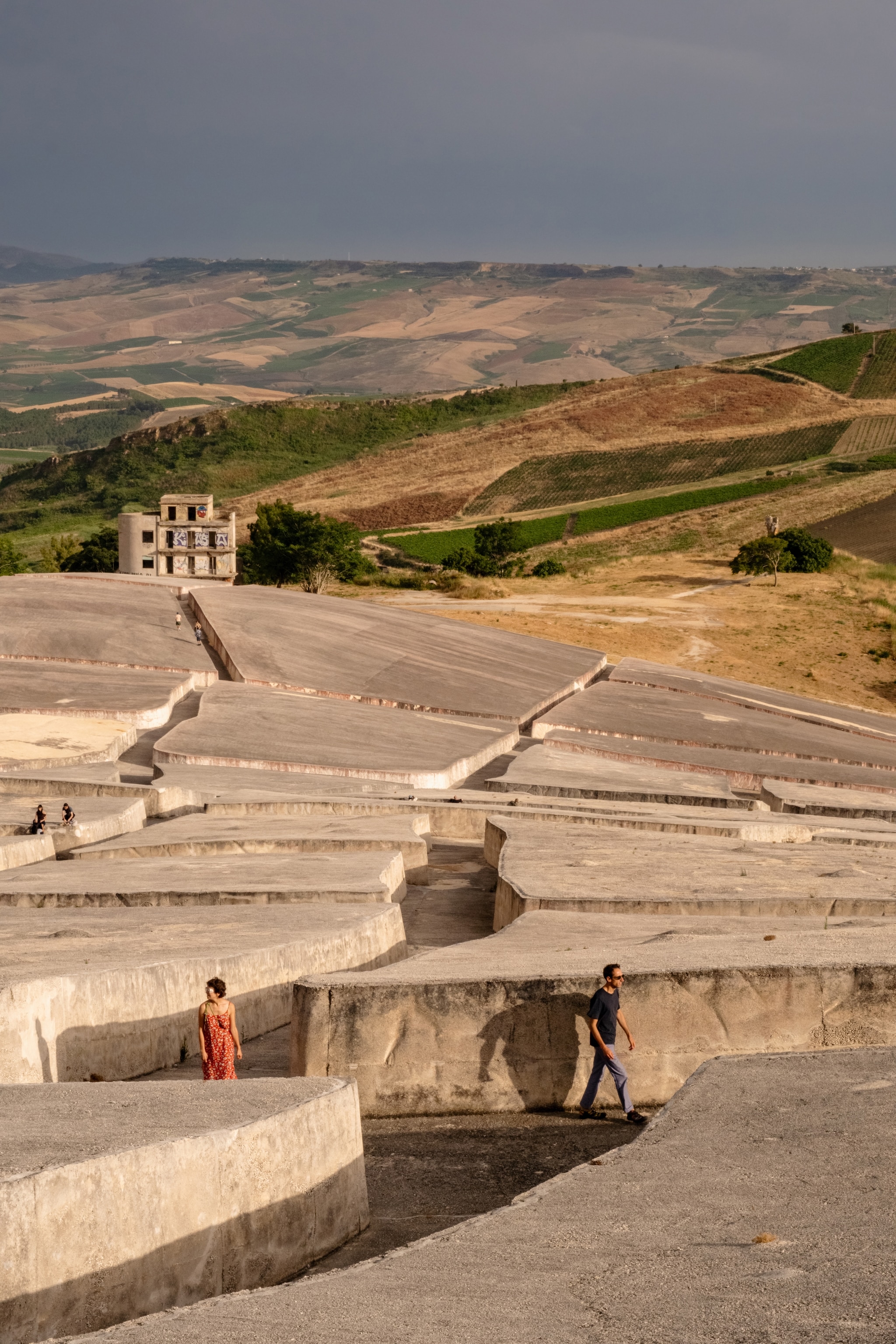
Cretto di Burri is a land art installation over the old site of Gibellina village. Francesco Lastrucci
Born in the valley four years after the disaster, Rossana spent her childhood in temporary tents and metal-sheet settlements. Many of her family’s photographs were lost; growing up, she’d sit with her grandmother, inventing stories around the fragments that remained. “The ruins fed my imagination,” she says. “Through a child’s eyes, I saw beauty in them.” She now lives and works in nearby Palermo, but Belìce continues to shape her practice.
Worth the detour
Rossana isn’t the first artist to find inspiration in the earthquake’s aftermath. Some two decades after the event, the late Italian sculptor Alberto Burri transformed the ruins of Gibellina Vecchia into a sprawling work of land art known as the Cretto, Italian for ‘crack’. From a distance, the Cretto di Burri resembles a grey patchwork blanket draped across the Sicilian countryside, soft hills painted in green and straw yellow — olive groves, vineyards, wheat fields stretching as far as the eye can see. Look closely, and you’ll notice it’s made of blocks of concrete, each sealing districts of the ghost town beneath it. Visitors can walk narrow corridors hemmed in by sun-warmed walls, tracing what were once streets and alleyways.
The Cretto aimed to preserve what had been lost — but also turn a new leaf. “My father said beauty was a necessity, not a luxury,” says Antonella Corrao, daughter of the late Ludovico Corrao, the mayor who oversaw the creation of Gibellina Nuova. We meet at Fondazione Orestiadi, an arts foundation her father established to champion contemporary art in the Belìce Valley, where Antonella and her sister Francesca Maria now serve as co-presidents. “There had been too much suffering, ugliness, pain,” she says, her gold bangles jingling as she gestures. “Only art could save the soul of Gibellina.”
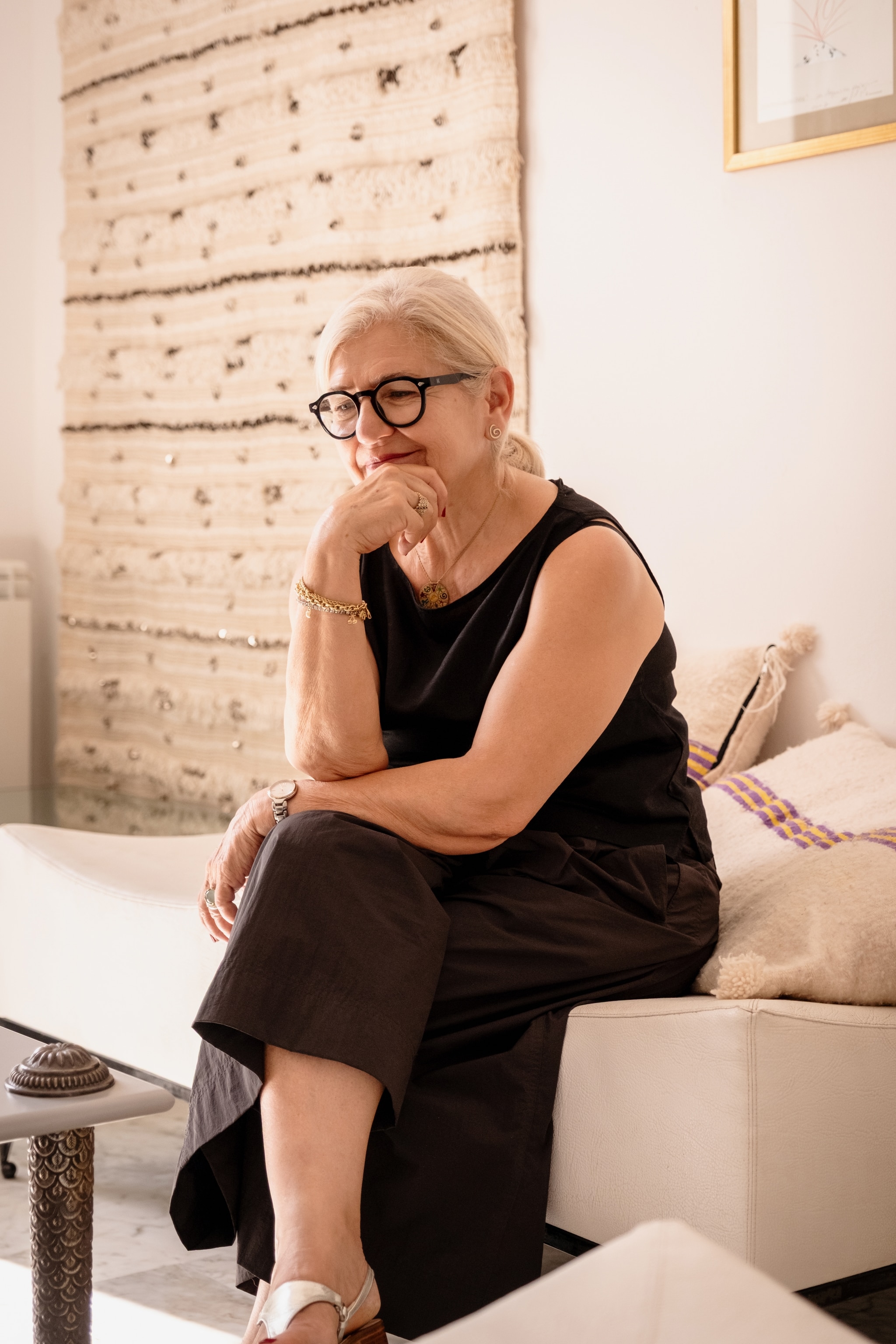
Antonella Corrao is the co-president of Fondazione Orestiadi. Francesco Lastrucci
It was a bold idea. Over the 1970s and 80s, Ludovico Corrao invited some of Italy’s leading architects, sculptors and artists to help shape Gibellina Nuova. An enormous metal star straddles the road leading to the town centre. Beyond it, low, grey apartment blocks sit alongside supersized sculptures made of metal, stone and concrete. There’s a bright white dome rising above the rooftops like a giant observatory. A huge concrete building curves into the sky. The whole scene feels surreal, as if pieces of a modern art gallery have been dropped into the middle of the Sicilian hinterland.
Repainting the picture
Today, Gibellina and the surrounding valley are home to over 5,000 works of art by some of Italy’s best-known contemporary artists — an extraordinary number for a town of around 3,600 people. It’s thanks to these cultural riches that Gibellina has been recognised as the country’s first Capital of Contemporary Art in 2026. Throughout the year, a programme of exhibitions, performances and artist residencies will take over its striking buildings, some of which have never opened to the public before.
Among them is the Teatro di Consagra, a hulking, wave-shaped structure pierced by giant oval openings, with a street running through it. Designed by the late Sicilian sculptor Pietro Consagra, it remained an empty shell for decades, without stage or seating. Now, it’s welcoming visitors for the first time, as an exhibition space. When I arrive, the sound of crashing waves and a tolling bell echoes across the bare concrete interior. At the far end of the theatre, where the stage likely would have been had the project ever been completed, three giant screens show a tyre with a bell strapped to it bobbing in the sea — a work by Albanian multimedia artist Adrian Paci, inspired by an ancient legend of a church bell lost off Italy’s Adriatic coast.
“People often talk about Gibellina as an open-air museum,” says Andrea Cusumano, a Palermo-based artist and the artistic director behind the Capital of Contemporary Art programme, as we walk through the town centre. “I almost find that offensive. First of all, it’s a town where people live. I don’t think we should be afraid of transforming cultural places into everyday places.”
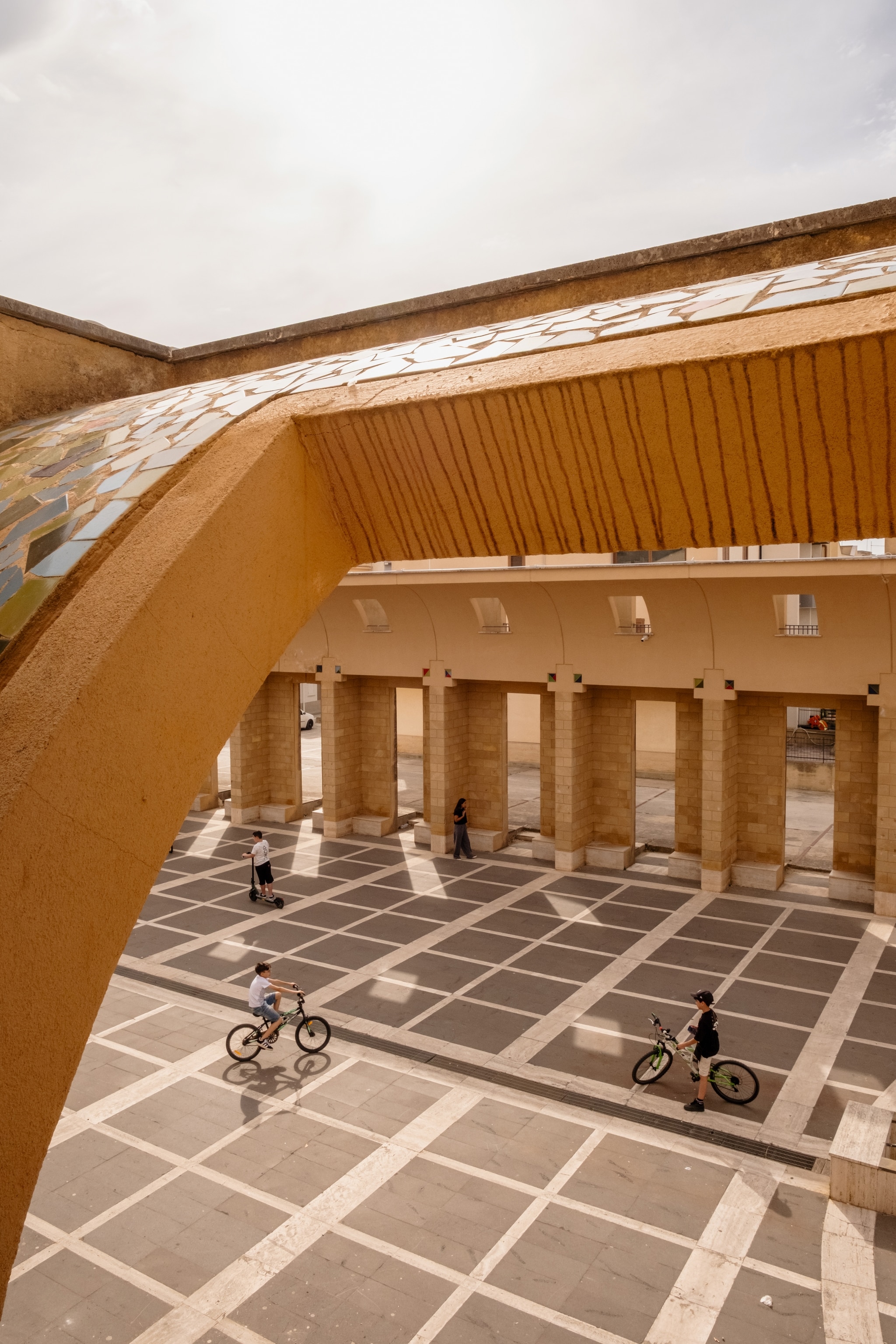
Gibellina Nuova has a system of interconnected squares. Francesco Lastrucci
We pass a tall concrete pillar with outstretched wings and a giant stone wheel; a rusted metal sculpture; a mural of three eyes staring at me from a wall. Eventually, we arrive at the Sistema delle Piazze, five interconnected plazas stretching for a quarter of a mile. There’s little shade apart from a few palm trees, and the fountains, no longer plumbed in, are empty but for the odd deflated football.
Architects Franco Purini and Laura Thermes designed the squares as a meeting place, but there’s no one here. “Locals are a little afraid of inhabiting them,” Andrea tells me. “It’s almost as if the city is missing an instruction book.” Many hope the 2026 events will breathe new life into these spaces. “There’s still room for Corrao’s dream,” Andrea says, “it just needs to be adapted to our times.”
As I’m about to leave, a group of children wheel their bikes across the piazza, filling it with laughter. For the first time all afternoon, Gibellina Nuova’s vast square feels alive. In that moment, I remember something Antonella Corrao had told me earlier. When asked which monument in Gibellina mattered most, her father had a simple answer: “Human beings,” she said. “It was never about art. It was always about people.”
Poggioreale Vecchia
How to do it
This story was created with the support of Audley Travel and Persefone Travel.
To subscribe to National Geographic Traveller (UK) magazine click here (available in select countries only).

