


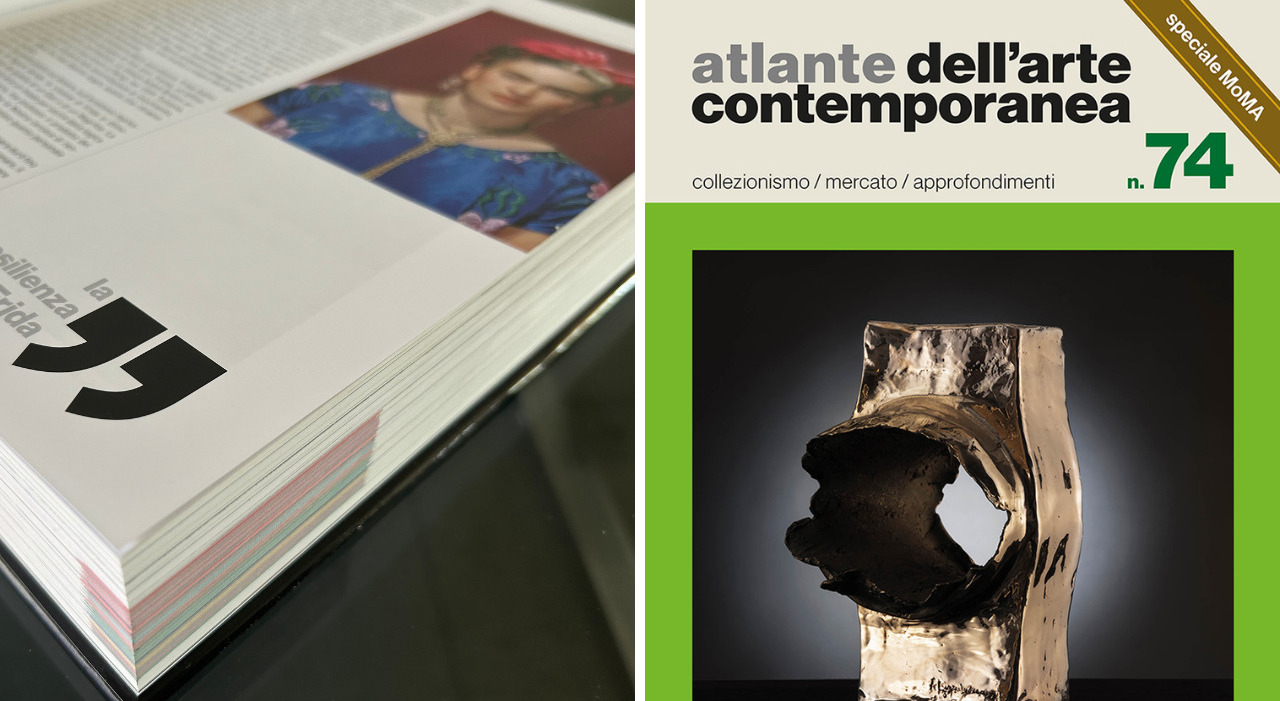
The historic Atlas of Contemporary Art, published by Giunti, the oldest Italian art yearbook (founded in 1940) now in its 74th edition, returns to bookstores in June with a cover dedicated to internationally renowned master Gabriele Maquignaz and a completely revamped graphic design.
The work, which will be previewed on June 5 in Rome at the eCampus University (via Matera 18), marks a radical turning point: from a simple tool for cataloging and consultation for professionals, the Atlas transforms into a manifesto of ‘active art,’ a vehicle for ethical and political messages capable of stimulating public debate and deconstructing the traditional hierarchies of the cultural system.
Abandoning its original nationalist approach in favor of an open and intercultural vision, the volume—directed by Daniele Radini Tedeschi—places inclusion, rights, gender issues, and social justice at its core. Art here is understood in its most militant and operative dimension: not pure aesthetics for its own sake, but an active force capable of uniting people and inspiring the courage and will to act against discrimination.
The pillars of the new edition
Identity and combating hate: Ample space is given to artists such as ADGART, whose series of works on marginalized cultural identities becomes a powerful symbol against racial and gender-based hatred.
Empowerment and Body Art: A specific focus is dedicated to the role of women in art, with in-depth discussions on the Roman collective ‘Rivolta Femminile’ (1970) and on body art, understood as an awareness of a free body and an independent identity. The active (often forgotten due to prejudice) presence of female artists in the twentieth-century avant-garde is also brought to light.
Disobedient bodies and Queer narratives: The Atlas maps marginal experiences, non-normative bodies, and those invisible in official documents, giving space to stories that are rarely told.
The words of Daniele Radini Tedeschi
Beyond national borders: The volume values the plurality of languages by hosting in-depth focuses on immigrant artists who have established their studios in Italy. “This year’s publication is finally a vehicle for a strong ethical message that aims to affirm human dignity beyond gender, sexual orientation, and skin color,” declares director Daniele Radini Tedeschi.
The words of Stefania Pieralice
Echoing him is author Stefania Pieralice, who emphasizes the political responsibility of culture: “We live in a contemporary era marked by lacerations and conflicts; art must take these disruptive social forces into account in order to help foster cultural and political responsibility.” Among the essays included, emblematic figures of this social urgency are analyzed, such as the Iranian Shirin Neshat and the work of Faè A. Djéraba, who address themes of censorship, exile, and the condition of women in Islam.
The presentation event
The opportunity to discover the work—whose cover is signed by master Gabriele Maquignaz and is already available for preview at the Book Pavilion of the Venice Biennale—is set for June 5 in Rome. The presentation will take place in a fascinating and historic location: a former 1930s neoclassical place of worship, located within the eCampus University (directed by Rita Neri), which houses frescoes attributed to Primo Conti.
© ALL RIGHTS RESERVED
This article is automatically translated