


Yuji & Ai Editorial #004|STORIES / JOURNEYS
Every time I look at hotel rates,
I find myself thinking,
“Was it always this expensive?”
I am no longer surprised by a rate of 100,000 yen per night.
Depending on the city or the season, it can be 200,000 or 300,000 yen.
If you look even higher, it is no longer unusual for a night to exceed $1,000.
Of course, exchange rates play a role.
Labor costs, food prices, and energy costs are all rising.
And globally, there is strong demand for luxury travel, particularly among the wealthy.
But as I look at the numbers, a question arises.
Luxury has certainly become more expensive.
But,
has the “richness” we receive during our travels increased by the same amount?
A world of $1,653 per night
Data released by the luxury travel network Virtuoso in August 2026 paints a very clear picture of the current situation.
According to Virtuoso, the average nightly rate for international luxury hotels in 2026 was $1,653.
In 2019, it was $985.
Within the United States, it has also risen from $790 to $1,445.
Yet, demand has not weakened.
Virtuoso’s 2026 sales are on pace for a year-over-year increase of approximately 21%, with the hotel sector up about 25%.
And interestingly, bookings for hotels at $1,500 or more per night are up 37%, significantly outpacing the growth of less expensive hotels.

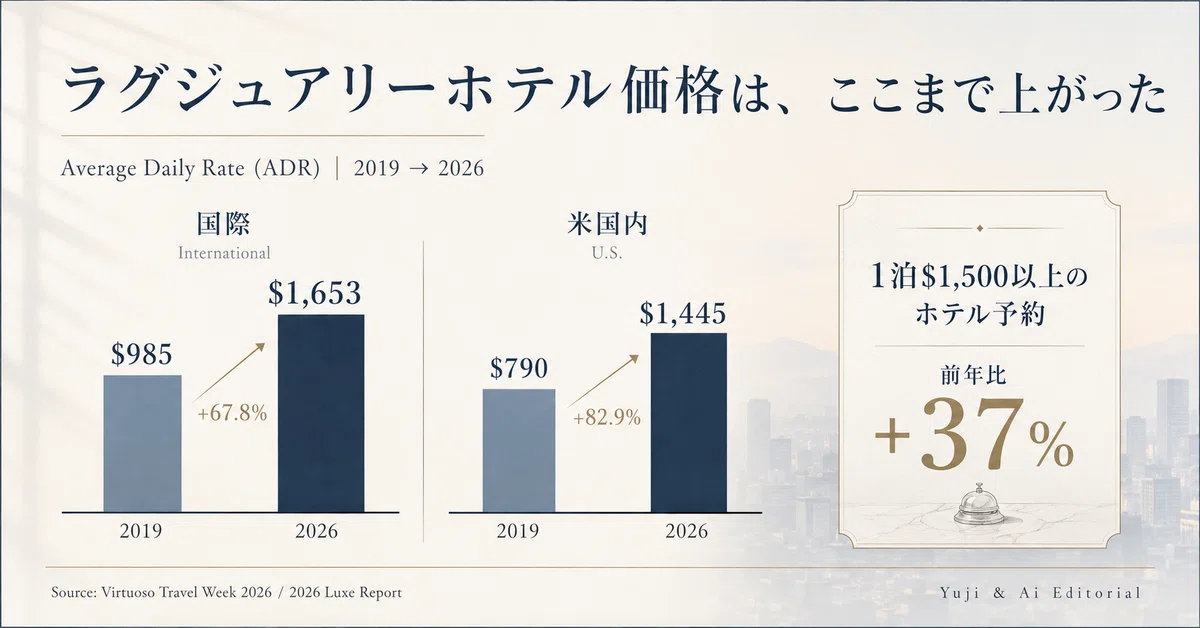
The average daily rate for international luxury hotels has risen from $985 to $1,653, and from $790 to $1,445 within the United States. Hotel bookings at $1,500 or more per night are also up 37% year-over-year.
Source: Virtuoso Travel Week 2026. Visualization: Yuji & Ai Editorial.
If prices go up, people leave.
That is what one would normally think.
However, that is not necessarily the case in luxury travel.
Rather, demand is concentrating at the highest end.
Is this simply a story of ‘more people having money’?
I think a slightly different change is also taking place.
From ‘going because it’s high-end’ to ‘paying because it’s worth going’
The 2026 Virtuoso Luxe Report states that while travelers still intend to spend high amounts, they are seeking clearer value in response to rising travel costs.
While 55% of responding travel advisors expect spending per trip to increase further, travelers are conscious of whether that expenditure will truly improve their experience.
I think this shift is quite significant.
Spacious rooms.
Marble bathrooms.
Luxury brand amenities.
Champagne.
Butler service.
These, of course, will continue to be the appeal of luxury hotels.
But if it were only those things, similar experiences could be created anywhere in the world.
In that case,
why do we go to that hotel?
Perhaps this question will become more important from now on.
Departing with FOMO, spending time with Slow-mo
One of the interesting phrases in this year’s Virtuoso Luxe Report was
“From FOMO to Slow-mo”
.
“If I don’t go now, I might never see it.”
“If I keep thinking ‘someday,’ I might lose the opportunity.”
Such FOMO—Fear of Missing Out—drives people to travel.
However, it is said that the opposite is true once they actually arrive at their destination.
They do not rush to see everything.
They stay in port for a long time.
They choose small camps.
They walk slowly through markets and towns.
They eat, drink wine, and linger in the land for a long time.
The reason for going is FOMO.
The way of spending time is Slow-mo.
Virtuoso analyzes that such travelers are increasing.
I feel this symbolizes that the meaning of the word luxury is beginning to change.
In the past,
“How many things can you experience in a single day?”
might have been a value as well.
But now,
being able to have time to do nothing.
Being able to look at the same scenery for a long time.
Knowing a place as it changes from morning to evening.
There are people who pay a lot of money for such things.
If you keep adding opulence, does it become luxury?
Hotels sometimes engage in strange competition.
Making rooms larger.
Making pools bigger.
Increasing the number of restaurants.
Making amenities more luxurious.
Adding more services.
And the room rates go up as well.
But, at some point, a question arises.
Is continuing to add “more” really the same as becoming richer?
Staying at a large hotel,
eating breakfast,
going to the spa,
Eat afternoon tea,
drink cocktails,
and go to dinner.
Spend the whole day following the schedule prepared by the hotel.
That is certainly luxurious.
But sometimes, it seems as if the traveler is the one adjusting to the hotel’s rhythm.
Conversely,
there is a chair by the window.
Beyond it lies a view unique to that land.
In the morning, you sit there.
You drink coffee.
An hour passes.
That is all.
But you might remember that one hour for years to come.
If so,
luxury may not be about the “quantity of what is provided,” but rather
returning your time to yourself.
perhaps.
Why is this hotel here?
Looking back at the hotels we have seen so far at Yuji & Ai Editorial, there is one thing they all have in common.
The Savoy is inseparable from the history of London.
Hope is tied to the long passage of time that transforms the Scottish landscape.
Fogo Island Inn is inseparable from the island’s community and its seasons.
Soori Penang is born from the shophouses of George Town and the childhood memories of a single architect.
I did not feature them because they are luxurious.
What I was always curious about there was,
“Why is this hotel located here?”
that was the question.
A hotel that has the answer to that holds a different kind of value, even if the rooms are a little small or it lacks one amenity.
Conversely, if a hotel could be moved anywhere in the world and still function, no matter how luxurious it is, it might be a weak reason to travel to that specific place.
The more expensive luxury hotels become,
the more strictly I want to hold onto this question.
If it is not a 200,000 yen room, is it not luxury?
And there is another important issue here.
If the price of luxury continues to rise,
will “rich travel” become something only for those with money?
I do not want to think so.
A hotel that costs 200,000 yen a night offers experiences that can only be realized because it costs 200,000 yen a night.
There is no need to deny that.
But,
Spending a quiet morning.
Walking through a town you didn’t know.
Looking at a building after learning its history.
Waiting for a single landscape to change.
Going to a shop that locals have frequented for a long time.
Listening to the sound of rain.
Such richness does not necessarily require a huge budget.
Perhaps what is more important is
being able to decide for yourself what to pay for and what not to pay for.
that might be it.
Instead of going to a hotel that costs 300,000 yen a night, stay longer at a place that costs 50,000 yen a night.
Choose a small room with a good view instead of a suite.
Skip the club lounge and have dinner in the town instead.
Instead of chasing famous hotels, choose one that can only be found in that land.
Build your journey not from price, but from
what is rich to you.
I think that, too, is luxury in this day and age.
Luxury may not be what is added, but what remains.

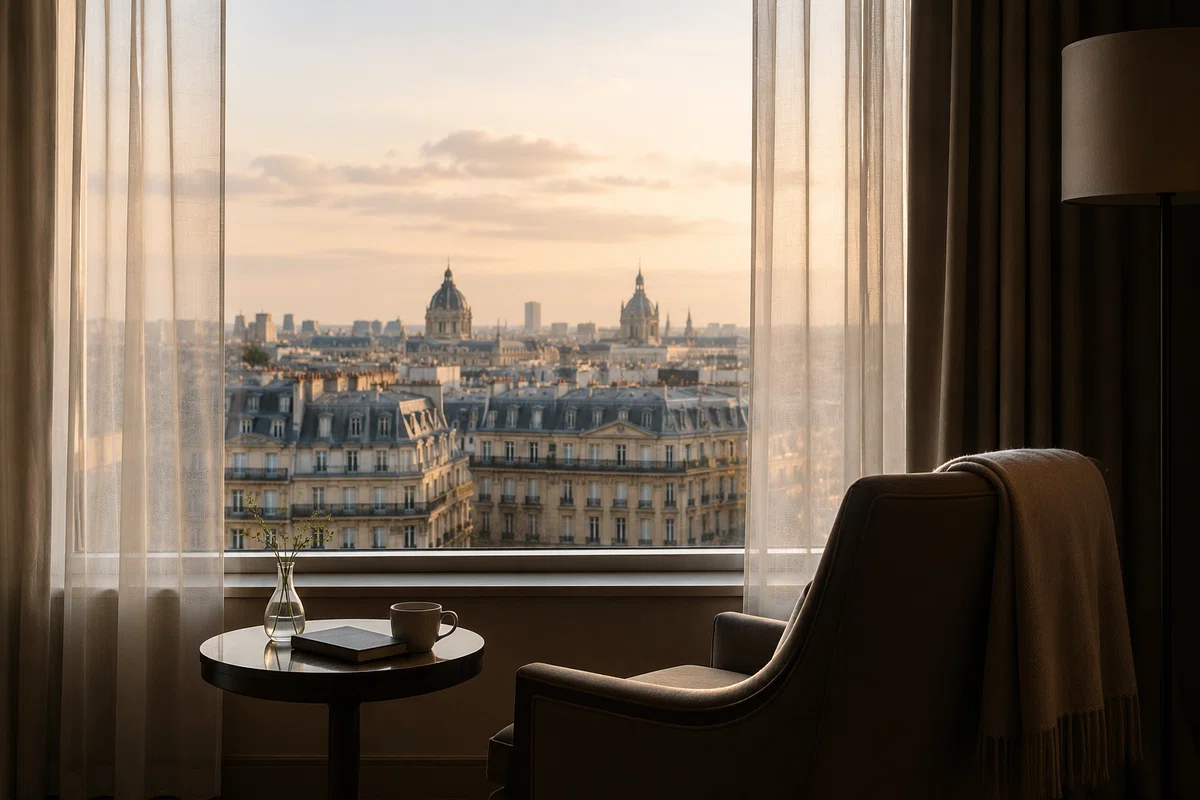
Not an ‘expensive hotel,’ but ‘unforgettable time’
Luxury hotels may become even more expensive in the future.
From an era where $1,000 a night is not uncommon,
to $1,500 a night,
$2,000,
and even beyond that.
If travelers still head there, hotels will be faced with a more difficult question than before.
What will you leave me with for that price?
Is it high-quality sheets?
Is it a beautiful bathroom?
Is it perfect service?
Or is it,
a single morning that I will suddenly remember even years later?
I am drawn to the latter.
After returning from a trip,
it is fine to forget the hotel room number.
It is fine to forget the names of the dishes.
But,
the way the world outside the window gradually grew brighter.
The way the sounds faded the moment I returned to the hotel from the city.
The way I walked through the garden after the rain.
How did I feel at that moment?
That is the only thing that remains.
If it is a place like that,
I feel I can at least say it was “luxury” for me.
Luxury has become expensive.
2026.
Looking only at the numbers, luxury travel is certainly becoming more expensive.
Even so, demand continues to grow.
People are still trying to spend money on travel.
However, what they are seeking beyond that may be changing little by little.
From seeing a lot,
to seeing deeply.
From possessing,
to feeling.
From experiencing things busily,
to pausing.
And,
from “how expensive it was” to “how much it remained within me.”
If luxury is changing in that way,
perhaps there is no need to lament only that it has become expensive.
However, as prices rise,
we also need to have a discerning eye when choosing a hotel.
Is there a reason why it must be this place?
Will the time spent here enrich my own time?
And finally,
what is it that I want to pay for?
When choosing your next trip,
before looking at the room rates,
I would like to think about these things a little.
Yuji & Ai Editorial
Hotels, cities, architecture, nature, and travel.
At Yuji & Ai Editorial, we look not only at whether a place is famous, new, or luxurious, but also at why it was created and what kind of time it has accumulated.
What we considered this time was,
are “price” and “richness” really the same thing?
In an era where travel is becoming more expensive,
I want to rethink what luxury means to me.
May this stillness reach your heart.
Sources / References
-
Virtuoso — 2026 Luxe Report
-
Virtuoso — 2026 Travel Week / Luxury Travel Trends
-
TravelAge West — Fall Travel Is Surging, Far-Out Bookings Are on the Rise and More Luxury Trends From Virtuoso
-
World Luxury Chamber of Commerce — The New Codes of Luxury Travel 2026
*This article is based on publicly available travel industry data and research, and is presented as a Yuji & Ai Editorial analysis. Prices and demand trends vary depending on region, season, exchange rates, hotel category, and other factors.

