

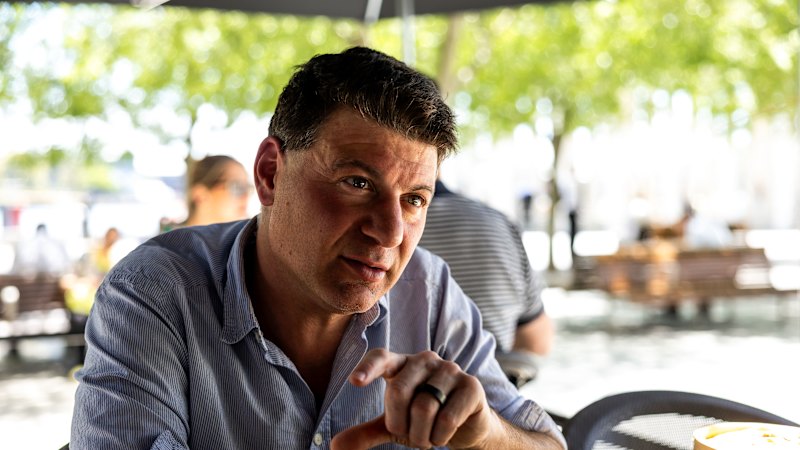
It’s a toasty 40 degrees at Lotus Barangaroo, an outdoor Asian restaurant with an excellent drinks list, and a glass of chilled Clare Valley riesling seems to be in order.
Except sitting opposite is Adam Schwab, the dynamic chief executive and co-founder of hugely successful Australian travel business Luxury Escapes. And not only is Schwab a vegetarian who likes running marathons barefoot, he doesn’t drink alcohol.
He’s also an extraordinarily fast talker who uses a lot of industry jargon – his favourite seemingly TAM (total addressable market). So I hand back the wine list, opt for a sober sparkling water and do my best to follow his rapid-fire conversation as the sweat trickles down my spine.
For those who haven’t heard of it, Luxury Escapes is a global travel platform offering exclusive holiday packages at discounted prices, featuring inclusions like meals and spa treatments. A loyalty program, Société, and a paid VIP club, LuxPlus+ (or Lux Plus Plus if you’re being pedantic) were introduced last year.


Schwab likes to talk about “innovation at velocity”, and with the brand’s swift growth (it now has an annual turnover approaching $1.4 billion, staff of 600 in five continents and a social following of 2 million), it’s clear he’s over-achieving in this regard.
It’s also evident that Schwab is incredibly driven – he’s been called a “consummate entrepreneur” and a “business genius with a Midas touch”. He, however, is rather more humble. “Mostly error, a bit of trial” is how he describes his start in commerce, after an early career as a corporate lawyer at Herbert Smith Freehills.
“One thing we are not bad at is learning from mistakes,” he says. “We’ve made heaps of mistakes along the way, like a million. We make mistakes every day. But we just try not to make the same ones again.”
Schwab and his co-founder Jeremy “Jez” Same, formerly an investment banker, began their first business at just 24: renting, furnishing and subletting apartments to backpackers. They had met at Melbourne’s Caulfield Grammar, where an early side hustle was selling VCE assignment notes to other students. Schwab’s mother was a teacher, and his father a self-employed builder, so in retrospect this initial stab at commerce seems an obvious first step.
I ask what drove him to leave a legal career to “basically move furniture around, about as unglamorous as you can get” with the apartment-letting venture. “It’s an interesting question,” he says. “Are entrepreneurs born, is it nature or nurture? Obviously, my dad had his own business so I experienced that level of risk from a young age, but back then being an entrepreneur was definitely not cool; Alan Bond and Christopher Skase were still front of mind. Now it’s different and if you fail, big deal, it doesn’t matter. But Jez embraces risk; without Jez pushing us I’m not sure we would have done that very first business.”

In the early 2010s, the pair moved into e-commerce with “flash sales” sites including deals.com.au, Cudo and Brands Exclusive. I remember Schwab from my time launching a (much smaller) gifts and homewares site around the same period, and he’s kind enough to refer to me as a “fellow founder”. It’s a generosity of spirit I note consistently throughout our conversation.
Luxury Escapes was born in 2013 when he acquired the travel-focused Getaway Lounge from Mi9, a digital division of Nine, and rebranded it, marking his shift from daily deal sites to a curated online marketplace of premium offers. In 2017, he also acquired the Catch Group’s travel brands (BonVoyage and Scoopon Travel) and consolidated them into Luxury Escapes. Luxury Escapes is an advertiser with Nine, the owner of this masthead.
It’s been expanding at pace since Schwab pivoted the company during COVID-19 border closures. While other online travel agencies were dealing with revenue dropping off a cliff and having to lay off staff, Schwab counterintuitively grew both his team and his business, switching the short-term focus from international to domestic travel.
“I think the ‘holy shit’ period lasted like a month,” he reflects now. “Back then [March 2020], everybody thought the whole COVID thing would only last three months. But international borders shut, so we had no choice [but to change the business model]. Fortunately, we were online-only at that stage, so we didn’t have to worry about closing stores, and our customers were really supportive and didn’t ask for refunds on future bookings, so we had positive cash flow. We just leant into our Australia-based business a bit more, and local hotels were more willing to work with us as well because they lost their international guests.

“It’s really 99.9 per cent luck,” he says somewhat modestly of the pivot. “You’ve just got to be in the right place at the right time 50 times. So that was one of a hundred other lucky breaks.”
Luck aside, that maverick move during COVID reflects his approach to business in general: he co-hosts a podcast called The Contrarians. He’s also known for being highly competitive, and for his aggressive stance against remote work. Luxury Escapes has offices in Australia, Britain, Spain and the US; he has described the shift to working from home as a “failure on every front” and famously told employees who prefer it to find a job elsewhere. “If you’d rather work from home maybe just work somewhere that does that, we’re not for you.“

Needless to say, this didn’t land well with many; on forums such as Reddit anonymous posters claiming to be former or prospective employees cited the five-day office mandate as a reason for declining job offers or leaving the company. They described the culture as “inflexible”, more about control than collaboration. On YouTube, prominent workplace commentators such as Joshua Fluke published videos criticising Schwab’s stance, with thousands of comments mocking the idea that “working from home will kill your career”.
Schwab is sticking to his guns. “There was probably a little bit of grumbling initially, but it was always the minority. It’s generally younger people who want to be in the office and who are positive about it. And if someone else wants to run their business with people working remotely, that’s fine. It gives us a competitive advantage, and it means the roads are quiet if we need to get to the airport!
“There are exceptions for mums and dads and people who need lots of flexibility,” he clarifies, “but our general view is we want people in the office five days a week. That’s probably our most contrarian mindset; we think in-person collaboration is massively beneficial.”
The enormous buffet lunch that is laid on for staff each day at the company’s South Melbourne headquarters probably doesn’t hurt in-office attendance either. Meanwhile, we barely notice the food arriving at our table, busy as we are discussing basket sizes (travel has a much bigger basket size, or average spend per customer, at $3000-plus, than our early respective forays into selling restaurant vouchers and cushions at $100 a pop).


His eventual switch to focusing solely on (more profitable) hotels, cruises and tours seems an obvious path to have taken, and makes me question why the quick-thinking Schwab didn’t recognise the commercial opportunity of his travel-focused site sooner (he persevered with his other e-commerce sites for several years after launching Luxury Escapes).
“Travel is a trust purchase,” he explains. “Once customers [on our database for other sites] had a good experience with an affordable restaurant voucher, we could upsell them to a more expensive luxury holiday.” He also had to build the brand over time, demonstrating its value to five-star hotels that were initially concerned about damaging their reputation by being on a sales site.
This all makes perfect sense, but then Schwab starts quoting Hamilton Helmer’s 7 Powers of Business Strategy framework – all cornered resources, counter-positioning and switching costs – and my brain is melting, so he eats most of the excellent salt and pepper tofu, dumplings and vegetable san choy bao while I desperately try to take notes that will be in some way meaningful later. (I’m recording the interview using Otter, an AI transcription app, but at Schwab’s breakneck speed even that struggles to keep up, I discover afterwards.)
Yet another strategy contrary to competitor businesses such as Booking.com or Expedia is Schwab’s move into glossy magazines and TV shows (aired on Foxtel). Even more daring is a play into physical retail. He opened a concept store in Melbourne’s Chadstone shopping centre in 2023 (after first experimenting with a pop-up), and in Bondi’s Westfield Junction in November.
Unlike your average travel agency, these “travel boutiques” mimic the atmosphere of a premium airline lounge, with velvet booths for consultations, a curved bar with free French champagne, barista-made coffee and fresh cookies, interactive LCD screens and highly trained (and purportedly highly paid) “travel specialists”.

Schwab says the typical online spend is $2000, whereas instore it’s $8000, so the investment would appear worthwhile. And the innovations keep coming. Just last month the company launched the first direct flights to the Maldives from Australia, shaving five hours off the usual flight time with weekly services out of Melbourne using Maldivian Air, and (naturally) your transfers and accommodation all packaged up neatly.
“We’re offering world-class holidays at unbeatable value, with all the inclusions,” he says. “Our launch offer is truly epic.” The superlatives and enthusiasm are non-stop; it’s like talking to a real-life Energiser Bunny.


Schwab’s high-intensity lifestyle (he’s up at 5am for a round of golf before his two kids wake up, is a devoted skier and regularly works 18-hour days) reflects his “hustle-first” philosophy; he often speaks about the importance of discipline and physical health, and views sleep as necessary “maintenance”.
Colleagues describe him as moving at a “million miles an hour”. A control-freak mentality (or what he calls “paranoid optimism”) is easily detected; he still checks every hotel before it’s signed up as a partner and monitors data like a tech-savvy hawk.
His desire to excel at everything extends to getting a professional expert to train him to DJ – he was on the decks at the company Christmas party.
I wonder where this constant will to succeed stems from. Does he simply want to be mega-rich? He says not, and talks genuinely about wanting to run a not-for-profit in the future. So what drives him? “I’m sure some people do it for the money, but not us. Jez and I don’t spend much. Ultimately, you end up dying or giving it away.
“We just want to do stuff that makes people happy, and get better at what we do. If people say Luxury Escapes is the best travel site, it’s like getting an A+ on your exam; everybody loves getting marked highly and, for us, this is a lifelong exam.”
As it turns out, Schwab’s highly rigorous approach to both his business and his lifestyle has other advantages too. When the no-meat, no-alcohol bill arrives, it’s the least I’ve ever paid for a long Friday lunch – just $93 for two. I may be exhausted from both the heat and Schwab’s relentless energy, but at least the bean-counters at Nine should be happy.
Start the day with a summary of the day’s most important and interesting stories, analysis and insights. Sign up for our Morning Edition newsletter.