

Art’s
imbrication in networks of money and power is hardly a contemporary phenomenon.
Many of the great masterpieces of Renaissance art, for instance, were commissioned
by members of the nobility. The origins of the modern picture trade date arguably
to the 17th century Dutch Republic, where, in the absence of
monarchical or church patronage, artists began producing domestically-scaled
genre paintings for sale on the open market. In the early 20th century, the art
dealer Joseph Duveen—later the 1st Baron Duveen of Millbank—made a fortune selling
Old Master paintings he acquired from cash-poor European aristocrats to wealthy
American industrialists like Andrew Mellon. As Duveen famously quipped, “Europe has a great deal of art, and America
has a great deal of money.” What has changed is speed and scale: There is, Adam
argues, more art being produced and sold than ever before, as artists,
galleries, and auction houses attempt to keep up with the demand of a new class
of international “UHNWIs,” Ultra High Net Worth Individuals attracted by the
lure of profit and prestige.
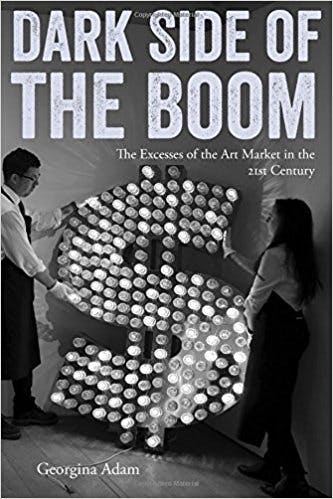
DARK SIDE OF THE BOOM: THE EXCESSES OF THE ART MARKET IN THE 21ST CENTURY by Georgina Adam
Lund Humphries , 208 pp., $34.99
As
Adam describes, two significant changes at the end of the 20th century
set the stage for today’s inflated contemporary art market. The first was the
expansion of the base of potential buyers: The fall of communism in Eastern
Europe and economic liberalization in countries like China and India created a
new wave of billionaires eager to flaunt their wealth. In China, which has
consistently ranked among the top three largest art markets by value since
2009, demand has also been boosted by a government-sponsored museum-building
boom. Over 1000 new museums, a combination of state-run and private
institutions, have opened in the past decade; as of 2017, there were approximately
200 privately owned museums devoted to contemporary art. Crucially, building
private museums serves not only as a status symbol for the country’s elite, but
a means of gaining state approval for lucrative real estate development deals.
The
second major change was the shift away from Old Masters and Impressionists as
the core of the auction business. Historically, selling contemporary art had
been the province of galleries and private dealers; the work of living artists
went to auction only infrequently. But the major auction houses, Sotheby’s and
Christie’s, recognized that promoting the contemporary market could open up
vast new revenue streams. They began to function more like luxury brands. Christie’s
was in fact purchased in 1998 by François Pinault, the owner of the European
luxury retail conglomerate Kering whose brands include Gucci, Saint Laurent,
and Balenciaga. The houses began aggressively hyping a never-ending flow of new
inventory, and with it, a jet-set lifestyle of multi-million dollar auctions, exclusive
gallery dinners, and VIP art fair vernissages.
