


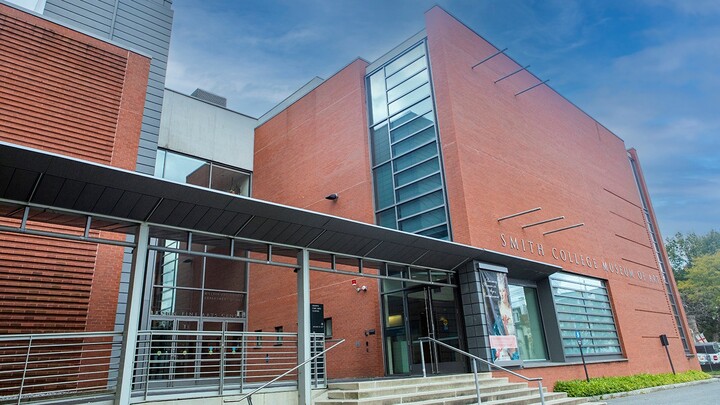
NORTHAMPTON — More than 100,000 objects in the shared collections of the five college campus art museums in Northampton, Amherst and South Hadley, and at Historic Deerfield, are accessible to the public on a recently launched updated website.
Five College Museums: Collections Online, at museums.fivecolleges.edu, is the public portal for a new collections management system designed to improve how the institutions identify, track and share information, with simplified searches for those using the database.
“This is truly a groundbreaking model for how a variety of museums can work together to connect, leverage and facilitate access to collections data,” said Sarah Pfatteicher, executive director of Five Colleges, Inc., in a statement.
The new online system was developed as a collaboration among Five Colleges, Inc., and the Smith College Museum of Art, the Hampshire College Art Gallery, Amherst College’s Mead Art Museum, the Mount Holyoke College Art Museum and the University Museum of Contemporary Art at the University of Massachusetts, as well as Historic Deerfield, which while independent, is closely affiliated with the campuses.
John Davis, president of Historic Deerfield, and Tricia Paik, director of the Mount Holyoke College Art Museum, have co-chaired the museum leadership council that oversaw the redesign effort that replaces what had become an outdated and increasingly inaccessible website.


Paik said in a statement that when Five Colleges embarked in the 1990s on the unique and ambitious initiative for six separate museums to share a single database, options for collections management systems were limited. That has changed in recent years.
“It was finally time to harness the best of what today’s technology has to offer,” Paik said. “With this new website, our shared collections are more easily searchable for our campuses, our western Massachusetts communities and from anywhere across the globe.”
Davis calls it “a powerful resource that would have been impossible for any of the individual museums to accomplish on their own.”
The effort at creating the new website became an opportunity for reimagining the way museum collaborations can share their online collections with each other and the world. London-based software agency Keepthinking carried out the design and development of the system.
Lorenzo Conte, director of Hampshire College Art Gallery and a leader of the team that designed Collections Online, explained in an overview recorded last summer that the new website is modular and adaptable.
“Our current site is a database, our new site is a storytelling platform and place of opportunity,” Conte said.
Conte also points to being able to feel the personalities of each of the six museums coming across to the public in a way that wasn’t possible with the earlier system.
“The online interface is much more intuitive, and won’t require specialized knowledge for people to find what they’re looking for,” Conte said. “It’s designed to help people more serendipitously discover things.”
Collections Online is underwritten by Five Colleges, Inc., and also relied on grants from the Mellon Foundation and the National Endowment for the Humanities, which in 2023 provided $350,000 to, in part, hire a full-time cataloguing librarian to work with the museums and cultural advisory councils.
The finished product is the result of years of collaboration among museum directors and registrars, working with Five Colleges Inc. staff members. Five College librarians, who have been successfully collaborating since the 1940s, were tapped for insights and inspiration, and grants from the Mellon Foundation and IMLS funded early prep work.
Jessica Nicoll, chief curator of the Smith College Museum of Art, said without Five Colleges’ support the project would have been far more expensive. The state-of-the-art technology, because it is collective rather than individual, also is transforming the way the public accesses the collections, making it a better user-experience for discovery.
Additionally, Nicoll said the improved website will have descriptions for objects that are standardized, and be sensitive to the cultural backgrounds from which the pieces come.
“A study last year of people accessing our collections showed that we need to be more accurate, equitable and transparent in how we describe objects if we want people to make the best use of these resources,” Nicoll said.
Siddhartha V. Shah, director of the Mead, said the Amherst College museum can show less than half of 1% of its 20,000 items at any one time.
“Having a system like this is really going to present them to the world, it’s really making significant use of this investment we’ve made,” Shah said.
The use of the website is illustrated in doing a search for “sport and athletics,” which returns images of dozens of art objects. These range from ancient sculpture to 21st century photographs.
When clicking on the picture of a woman swinging a golf club, it describes this as a pastel on paper, created by James Champney in 1897 and part of Historic Deerfield’s collection. The accompanying text offers a biography of Champney and a description of the image and how it was received at the time of its creation.
Also included are images and links to work by Champney at the other museums, as well as information about Historic Deerfield and its collection.
Five Colleges sees Collections Online as a case study in cross‑institutional collaboration, academic stewardship and digital transformation, highlighting how colleges can pool expertise and resources to create scholarly and public value that no single institution could achieve alone. This also comes at a time when campuses across the country are under pressure to do more with fewer resources.

