

► A collection exhibition in Tokyo for the first time in about 30 years
|The Suntory Museum of Art (Minato Ward, Tokyo) is hosting a collection exhibition from the Itsuo Art Museum (Ikeda City, Osaka). The very fact that this is happening is interesting, as it reveals a background of “relationships forged in the modern era.” This is because Ichizo Kobayashi (pen name: Itsuo) had a second daughter, Haruko, who married Taro Torii, the eldest son of Suntory founder Shinjiro Torii, creating a familial bond between the Kobayashi and Torii families. I cannot help but feel that this is where it all began.
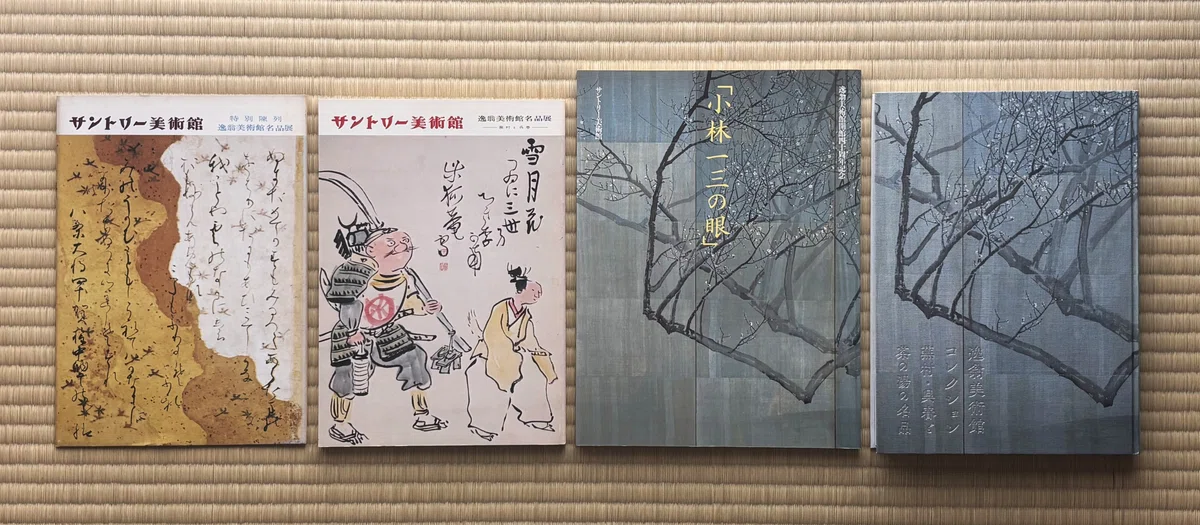
Whether or not that is related, the Suntory Museum of Art has held Itsuo Art Museum collection exhibitions three times in the past (*). Including this current exhibition, the list is as follows. I have also noted the number of items exhibited (total number including those rotated) and the location of the museum at the time of the exhibition.
① 1974: “Special Exhibition: Masterpieces of the Itsuo Art Museum,” 75 items / Palace Building, Marunouchi, Chiyoda Ward
② 1981: “Masterpieces of the Itsuo Art Museum: Buson and Goshun,” 141 items / Suntory Building, Akasaka, Minato Ward
③ 1997: “Itsuo Art Museum 40th Anniversary: The Eye of Ichizo Kobayashi,” 100 items / Same as above
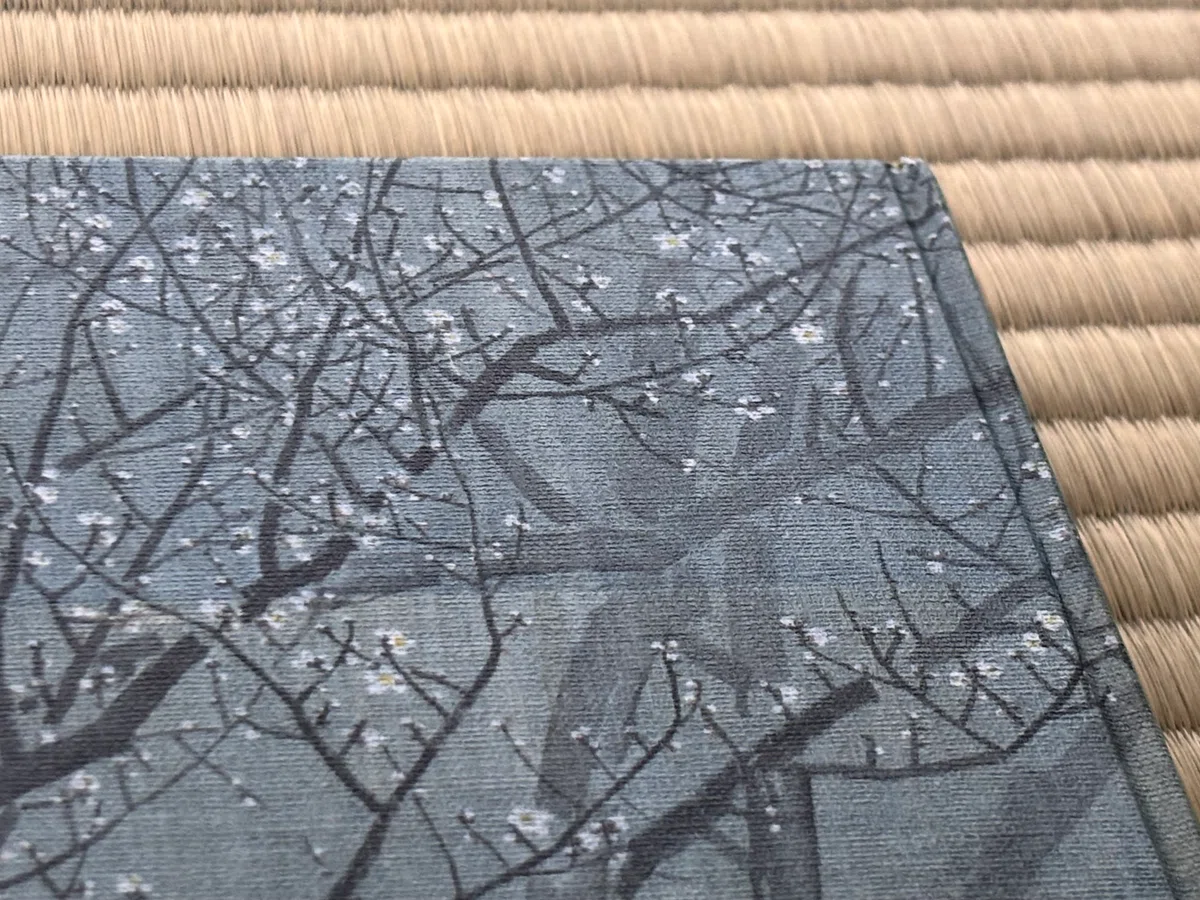
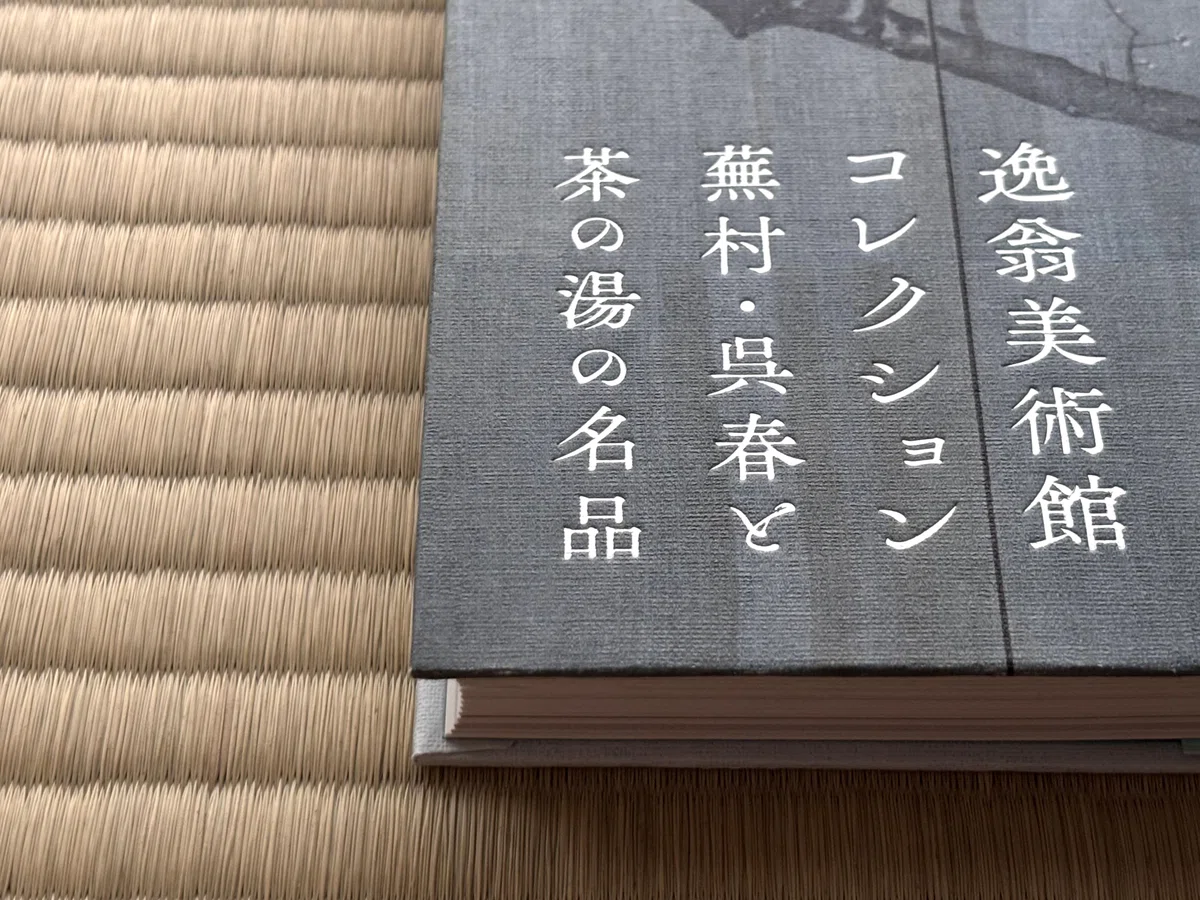
④ 2026: “Itsuo Art Museum Collection: Buson, Goshun, and Masterpieces of Tea Ceremony,” 149 items / Tokyo Midtown, Akasaka, Minato Ward
From the above, we can see that: ① in terms of the number of items, this exhibition is the largest ever (albeit by a small margin), and ② it is the first Itsuo Art Museum collection exhibition in about 30 years. I happened to have the past exhibition catalogs on hand, so I headed to the Suntory Museum of Art looking forward to seeing the results of the research and surveys that have been accumulated over these 30 years.
It was the modern tea enthusiasts who were responsible for the movement of art objects and tea utensils in the modern era. When you think about it, a collection exhibition held by one museum (or gallery) at another can be called a “small movement (round trip) of art objects” in the modern day, intended for public viewing. The “movement” of the Itsuo Art Museum collection exhibitions, which have been held repeatedly at the Suntory Museum of Art, must reflect the museum’s intentions regarding how to display Ichizo Kobayashi and his collection, as well as the needs of the viewers who want to see them, which makes it truly interesting from that perspective as well.
(*) Although not at the Suntory Museum of Art, in 2010, the Yamanashi Prefectural Museum of Art, located in Kobayashi’s hometown, held “The World of Ichizo Kobayashi: Focusing on Masterpieces of the Itsuo Art Museum.” That exhibition featured 50 items from the Itsuo Art Museum, including Important Cultural Properties.
► The title and chapter structure of this exhibition
First, regarding the transition of the Itsuo Art Museum collection exhibitions as seen from the catalogs of the past three events, we can generally say the following.
The first exhibition (1974) featured a carefully selected, well-rounded collection of masterpieces from among tea utensils, crafts, calligraphy, and paintings, but the second exhibition (1981) focused on the Maruyama and Shijo schools, centered on Yosa Buson and Goshun (Matsumura Gekkei). Looking at the content, out of a total of 141 items, 51 were by Buson, 59 were by Goshun (including related items), and 31 were works by other Maruyama and Shijo school artists. No tea utensils or crafts were exhibited at all.
The third exhibition (1997) saw Buson and Goshun fade into the background again, with content that provided an overview of the entire Kobayashi collection. Out of a total of 100 items, the balance was 12 by Buson, 10 by Goshun, and 5 by other Maruyama and Shijo school artists.
So, how about this exhibition? Judging by the title of the exhibition, “Buson” and “Goshun” are highlighted. However, “Tea Ceremony” has been newly added, and the chapter structure is as follows. I have also noted the number of items exhibited in each chapter (including the entire period) and the number of Important Cultural Properties.
Chapter 1: “Old Calligraphy and Sutra Scrolls,” 16 items / 8 Important Cultural Properties
Chapter 2: “Medieval and Early Modern Paintings and Crafts,” 23 items / 5 Important Cultural Properties
Chapter 3: “Buson, Goshun, and Paintings of Early Modern Schools,” 30 items / 2 Important Cultural Properties
Chapter 4: “Itsuo’s Tea Utensils,” 57 items / 0 Important Cultural Properties
Chapter 5: “Modern Artists and Itsuo,” 19 items / 0 Important Cultural Properties
Chapter 6: “Meiji, Taisho, and Showa: The Life of Itsuo, Ichizo Kobayashi,” 4 items / 0 Important Cultural Properties
Comparing the numbers, we can see that tea utensils are overwhelmingly numerous, but looking at the ratio of Important Cultural Properties, Chapter 1, “Old Calligraphy and Sutra Scrolls,” stands out. Even taking into account that cultural property designation is just one indicator, it is clear that “Old Calligraphy and Sutra Scrolls” shape the quality of this exhibition, while “Tea Utensils” shape its quantity.
Even so, the reason “Buson” and “Goshun” are featured in the exhibition title is likely because they clearly express Kobayashi’s characteristics (tastes), which differ from those of other collectors. In fact, as the 1981 exhibition shows, it is possible to hold an exhibition of almost the same scale as this one using only works from the Maruyama and Shijo schools, centered on Buson and Goshun.
► The Modern Era in Which Itsuo Lived
While the title of this exhibition reflects Kobayashi’s characteristics as a collector, its content attempts to capture the entirety of the person known as Ichizo Kobayashi. This is symbolized by Chapter 5, “Modern Artists and Itsuo,” and Chapter 6, “Meiji, Taisho, and Showa: The Life of Ichizo Kobayashi.” These chapters can be said to represent a major change (the progress of research and investigation) from the previous exhibition held about 30 years ago.
In Chapter 5, in addition to the painter Kason Suzuki and the lacquer artist Ryosai Misago, the exchanges between Kobayashi and figures such as Rosanjin Kitaoji, Kanjiro Kawai, and Akiko Yosano were highlighted. This, along with the exchanges with modern tea enthusiasts such as Yasuzaemon Matsunaga, Issei Hatakeyama, and Keita Goto mentioned in Chapter 6, is content that the Itsuo Art Museum has focused on in various exhibitions to date. Just by looking back at the exhibitions held since 2010 that are published on the Itsuo Art Museum’s official website, the following exhibitions can be confirmed.
① 2011 “Akiko Yosano and Ichizo Kobayashi”
② 2012 “Modern Japanese Paintings Loved by Ichizo Kobayashi”
③ 2013 “Tea Ceremony Exchange Records: Ichizo Kobayashi and Yasuzaemon Matsunaga — Masterpiece Collections of Itsuo and Jian —”
④ Ibid. “Tea Ceremony Exchange Records: Ichizo Kobayashi and Modern Tea Masters”
⑤ 2018 “Tea Ceremony Exchange Records III: The Aesthetic Eye of Eastern and Western Enthusiasts — The Collections of Hankyu’s Ichizo Kobayashi and Tokyu’s Keita Goto —”
⑥ Ibid. “Blooming in Department Stores — The Hankyu Craft Association and Modern Artists —”
⑦ 2021 “The Phantom Genius Painter: Kason Suzuki Exhibition — The Resurrected World of Flowers, Birds, Wind, and Moon —”
In other words, although the number of items exhibited in Chapters 5 and 6 was not that large, it means that there is enough accumulation to make the content even more substantial if only the capacity of the exhibition space can be secured. As someone interested in modern and contemporary tea enthusiasts and their interactions, I sincerely hope that a large-scale exhibition that further delves into Chapters 5 and 6 of this exhibition will be held in Akasaka, Tokyo, but… since anyone can just wish for things, I will write about some more complicated matters as I please.
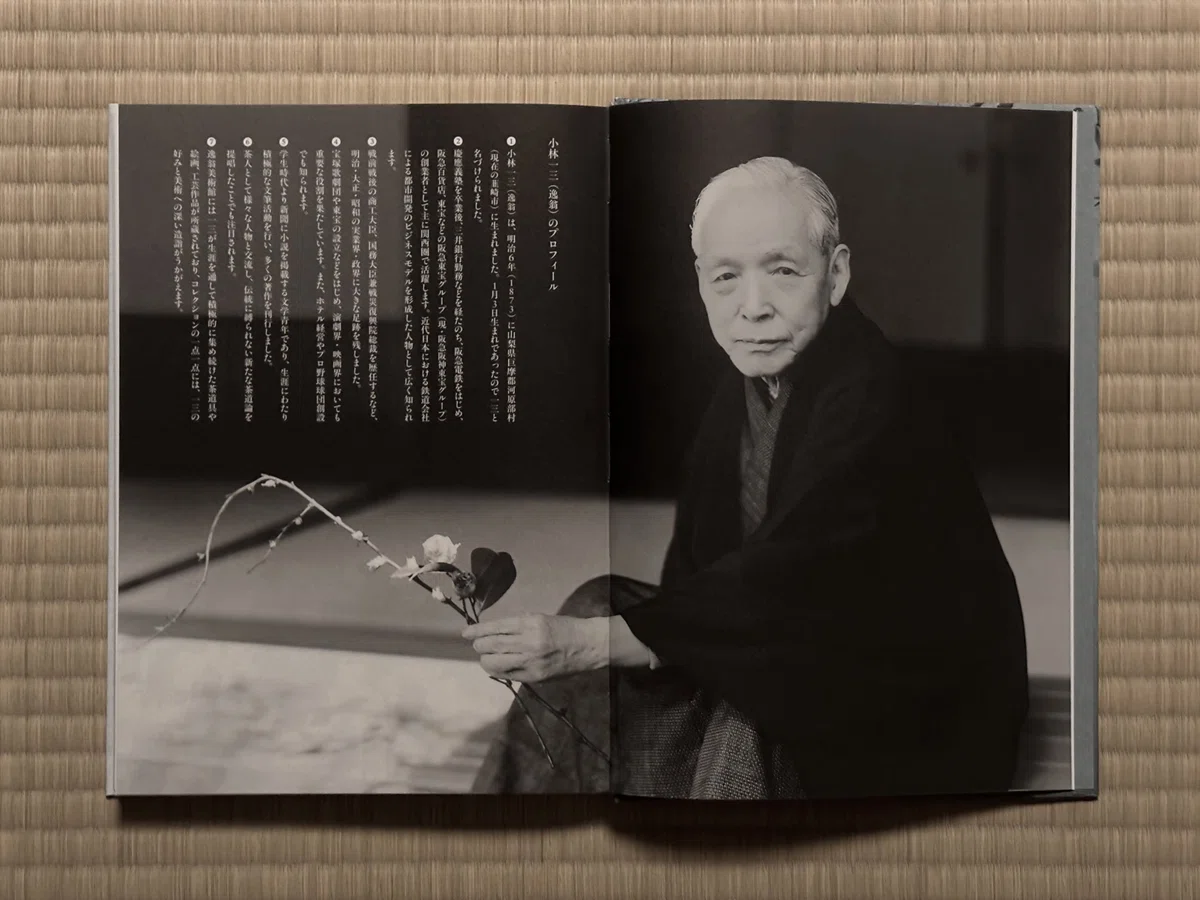
The lead text for Chapter 6 stated the following: “In this chapter, by tracing the achievements of Ichizo Kobayashi, who lived through the Meiji, Taisho, and Showa eras and showed remarkable activity in various fields, we would like to explore what influenced the formation of his collection.”
From the various materials exhibited, one can see that he wrote novels as a literary youth during his Keio University days, that he became interested in the tea ceremony under the influence of Yoshio Takahashi (pen name: Soan) during his young days at Mitsui Bank, or that he was interested in new paintings at that time. Also, his unparalleled management skills and naming sense demonstrated at Hankyu Railway (and its predecessor, Minoo Arima Electric Tramway), Hankyu Department Store, Takarazuka Revue, and Toho, as well as his entry into the political world, his exchanges with modern tea enthusiasts, and his famous “one city, one museum” concept are also covered. However, the impression is that how these influenced Kobayashi’s collection was not explored that deeply in this exhibition.
For example, political scientist Takeshi Hara, who is interested in modern railway projects, points out in his recent book “History of Japanese Political Thought” (Shinchosha, 2025) that Kobayashi was influenced by the way of life and thoughts of Yukichi Fukuzawa, and that this is reflected in his railway management.
The person who elevated railways to a form of ideological expression was Ichizo Kobayashi, who founded Hankyu. (…) As Ichizo Kobayashi recalled, “I have been taught independence and self-reliance at Keio since I was a young man, and my social life is exactly that” (from “My Way of Life,” included in the aforementioned “Complete Works of Ichizo Kobayashi,” Vol. 3), he was deeply influenced by the way of life and thoughts of Yukichi Fukuzawa, who refused to accept decorations or official ranks throughout his life and maintained his stance as a private citizen. Kobayashi took to heart the warning Fukuzawa issued in “An Encouragement of Learning”: “There is hardly any private enterprise in the world that does not involve the government in seven or eight out of ten cases. Because of this, people’s hearts are increasingly swayed by that trend, admiring the government, relying on the government, fearing the government, and flattering the government, without ever revealing a heart of independence, and the ugliness of this is unbearable to look at” (Iwanami Bunko, 1978).
If one is to pursue the person of Kobayashi through the Kobayashi collection, one cannot avoid touching upon his ideology in the end. At that time, an interdisciplinary approach will likely be necessary. In recent years, speaking of exhibitions that have become a topic of conversation by shedding light on an individual’s inner life, there is the special exhibition “The Great Universe of Koetsu Hon’ami” held by the Tokyo National Museum in 2024. That exhibition highlighted that there was a deep faith in the Lotus Sutra in the background of Koetsu’s various creative activities.
Compared to Koetsu, the materials regarding Kobayashi are enormous. In Kobayashi’s case, he was also able to write, so his own books are abundant. I sincerely hope that interdisciplinary research, including not only art history and tea ceremony history but also economic thought, political thought, and literary perspectives, will progress further and that exhibitions introducing them will be held. Even without being told by me, a single observer, at this late stage, I assume that the research of curators and experts in each field is accumulating day by day…
► The “New Tea Master” Seen by Kobayashi
Now, from the perspective of Honan Tayama, who is the subject of my research, and modern tea enthusiasts, I will introduce just two stories related to Ichizo Kobayashi that I personally feel close to.
Kobayashi and Tayama primarily had contact through the Enmei-kai. Kobayashi recognized Tayama as a “person who could read” ancient documents such as ink traces, and there is a sense that he valued such talent. Furthermore, Kobayashi wrote about a story he heard at an Enmei-kai meeting held at Keita Goto’s residence in 1950 in his own work as follows.
There are two streams of new tea in Tokyo. One is that people who appreciate ceramics as a hobby have eventually entered the world of tea, and because they naturally have their own discernment regarding utensils, whether ceramics or lacquerware, they can create a magnificent arrangement. The things they use are logical, and they know beautiful things. However, the hanging scrolls in the alcove look inferior by comparison.
The second group consists of tea practitioners who came down from the alcove, that is, people who started by collecting ink traces, old calligraphy, Buddhist paintings, and ink wash paintings, clinging to scholars as their lifeline. Among them, people like Houn Tayama, Shokin Furuta, and others have joined, but they do not yet have that much enthusiasm for appreciative hobbies.
However, these two streams will eventually merge to become a group of new tea practitioners. What is perfected by that is Tokyo tea, and Japanese tea. The master of today, the old man Goto, is a collector who, even if he hangs a kettle every month, will never have trouble with ink traces for the rest of his life, and so on.
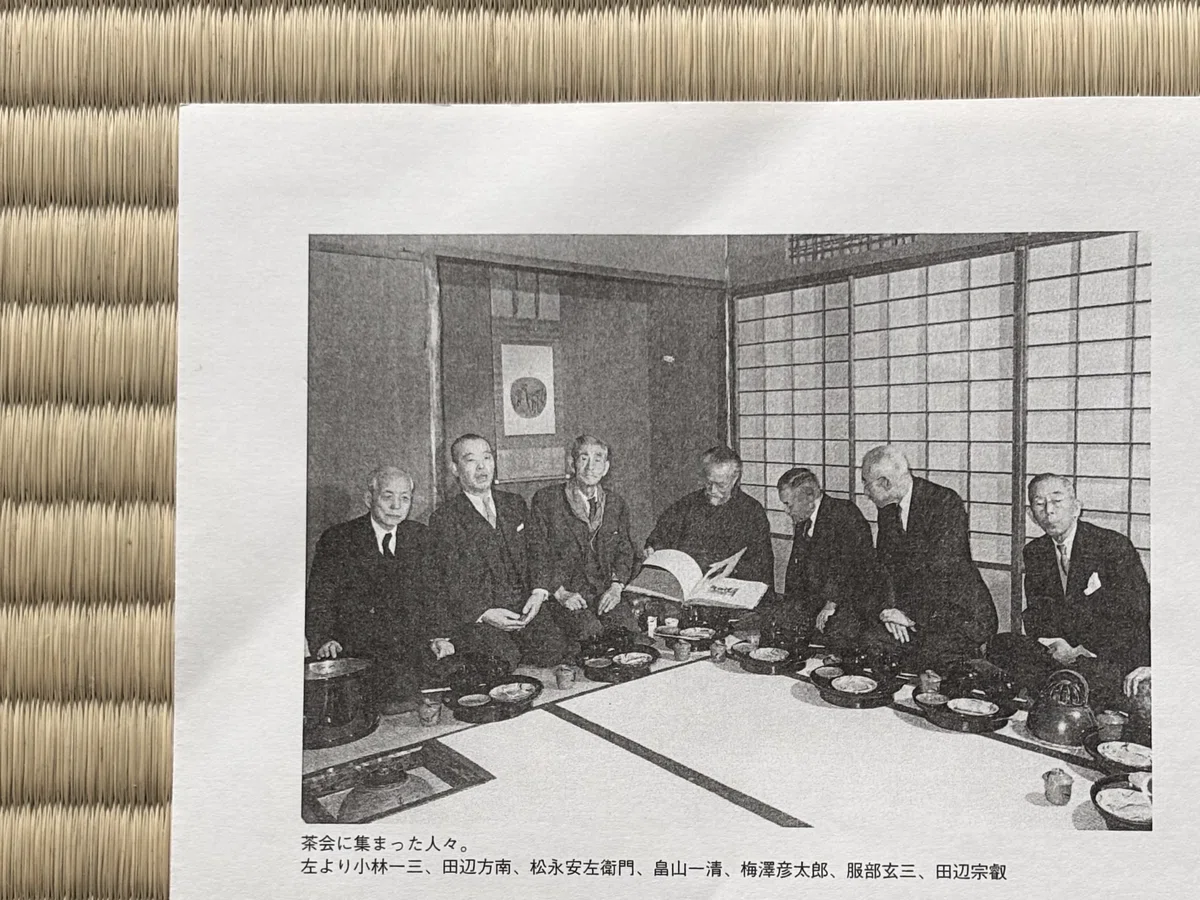
What is particularly interesting is the phrasing “tea practitioners who came down from the alcove” directed at Tayama. Even if it was not Kobayashi’s own words, since he went out of his way to introduce it in his own work, I infer that there were parts he sympathized with or aspects he found amusing.
As in the story introduced by Kobayashi, after Tayama retired from the Ministry of Education, he visited famous kilns all over the country and became absorbed in “hand-molding.” It could be said that Tayama’s own works are by no means refined, or rather, it would be more appropriate to call them “getemono” (low-quality goods), but could it not be said that he became a member of the “group of new tea practitioners”?
The quoted text above, while clearly pointing out those who do not understand the scrolls in the alcove or the appreciative value of tools at that time, also possesses a gaze directed toward the future of what will become of those people. It is precisely because Kobayashi had a similar gaze that he went out of his way to introduce it in his own book. That gaze toward the future overlaps in my mind with the concept of “New Tea Ceremony” (*) proposed by Kobayashi.
Kobayashi’s tea ceremony was always open to new things. If one views the world with Kobayashi at the center, it is not impossible to say that new tea practitioners like Tayama were invited into that wide opening.
(*) Regarding the “New Tea Ceremony,” it is written in the exhibition catalog as follows: “Just as he valued ingenuity and creative ideas as a businessman, in the tea ceremony, he respected tradition while incorporating new tastes. He proposed a ‘New Tea Ceremony’ of ‘Simplicity is Tea Ceremony’ and ‘Art is Tea Ceremony,’ such as using Western crafts as tea utensils, applying Western food and rice bowl dishes to kaiseki cuisine, and mixing regular tea kaiseki with ryurei-style seating.” (p. 202)――.
► Modern Connoisseurs and Itsuo
Finally, I will introduce a modern connoisseur who is rarely looked back upon, whom it is no exaggeration to say was discovered by Kobayashi’s gaze toward the future. His name is Michikazu Hattori (other Go: Baiso, Soan, Rozansan; real name: Shozo?).
Hattori was a tea practitioner and tool dealer born and raised in Ise, Mie, and his family home seems to have been a prestigious tea family. After training in tea utensils in Kyoto, he went to Tokyo and, following the words of Donno Masuda, served as a tea master for over a decade.
After the war, he returned to his local Ise, opened the Rozansan Kiln, and began working in pottery, and in 1951, he moved to Kita-Kamakura. In Kamakura, he reportedly showed his face at the “Kojitsu-kai” and “Kitakura-kai” by local connoisseurs, as well as the aforementioned “Enmei-kai” (I will leave more detailed information to an past article).
Even now, tea utensils fired at the Rozansan Kiln are occasionally sold at online auctions, but it is no exaggeration to say that they are items that hardly catch anyone’s eye anymore. However, when Hattori began pottery at the Rozansan Kiln, it was Ichizo Kobayashi who was the first to take notice of his work.
An old document where the Rozansan Kiln can be confirmed is the November 1948 issue of “Nihon Bijutsu Kogei” (Nihon Bijutsu Kogei-sha). It contains an advertisement for the “First Rozansan Kiln Pottery Exhibition” (held from November 12 to 14 of the same year) held at the “Hankyu Department Store 6th Floor Jumbi Hall,” and Ichizo Kobayashi himself wrote the “Introductory Words.” Since it is a document that is probably almost never looked back upon, I will transcribe the full text.
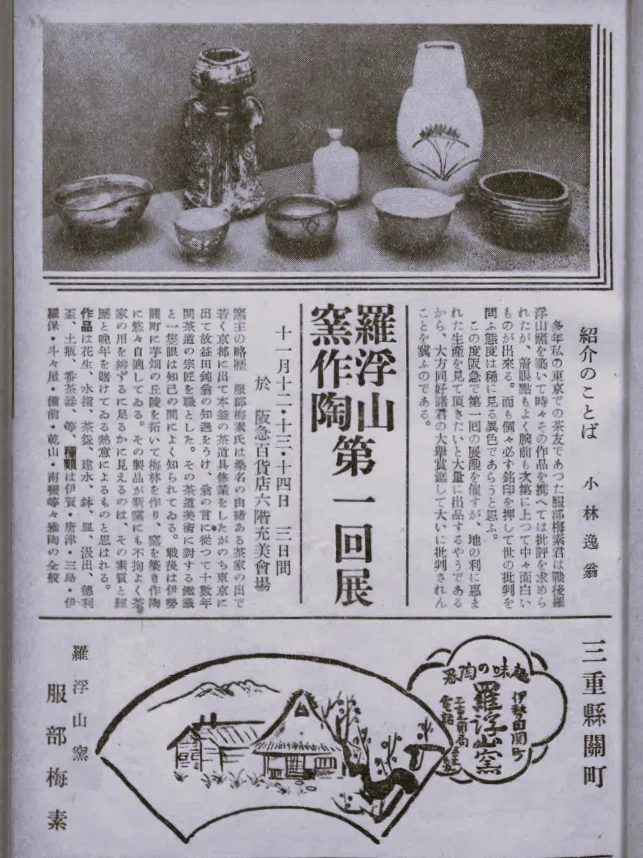
Introductory Words: Itsuo Kobayashi
My tea friend in Tokyo for many years, Mr. Baiso Hattori, built the Rozansan Kiln after the war and would occasionally bring his works to ask for my criticism. His focus is good, his skills are gradually improving, and he is making quite interesting things. Moreover, his attitude of always stamping his mark on each piece and asking for the world’s criticism is, I think, a rare and unique quality.
He is holding his first exhibition at Hankyu this time, and since he seems to be exhibiting a large quantity in the hope that you will see the production blessed by the location, I hope that all of you who share his interests will come in large numbers to appreciate and criticize him greatly.
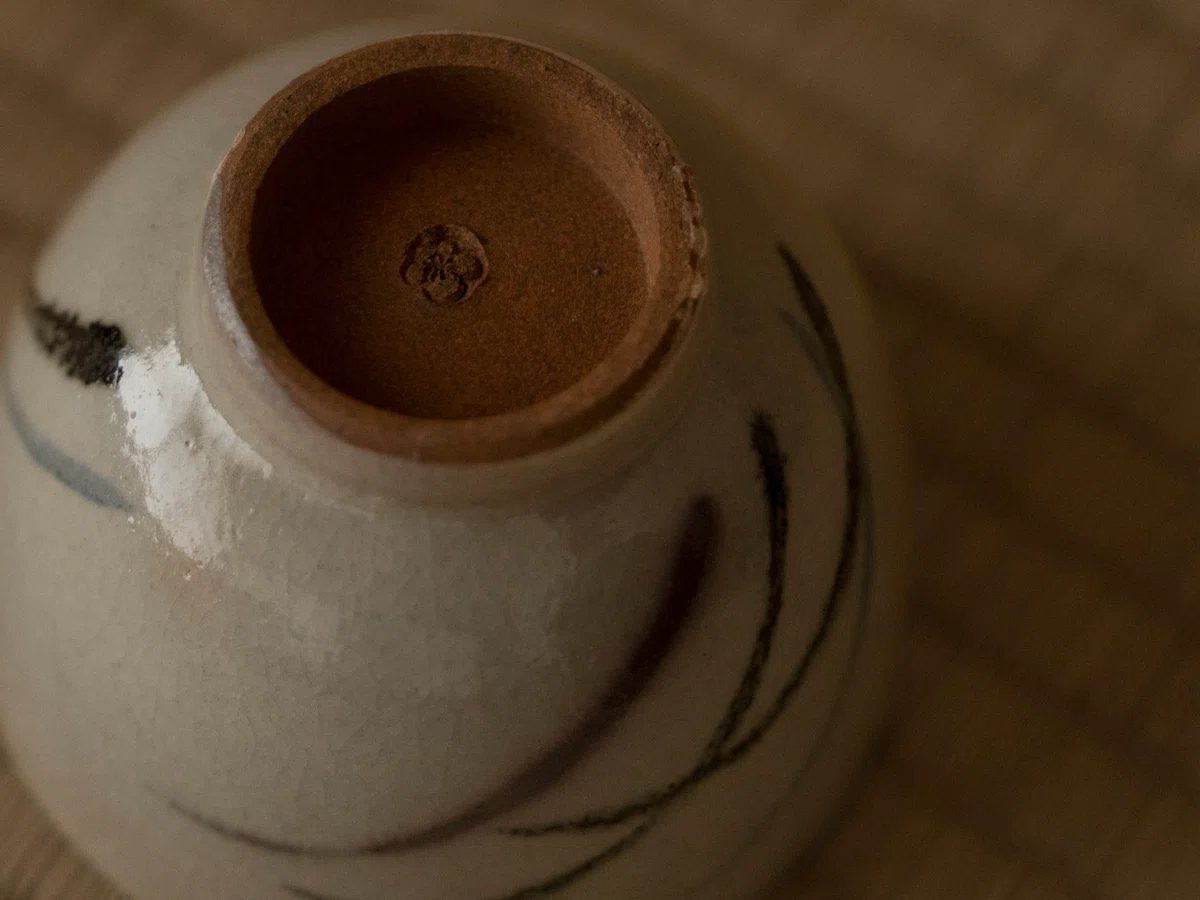
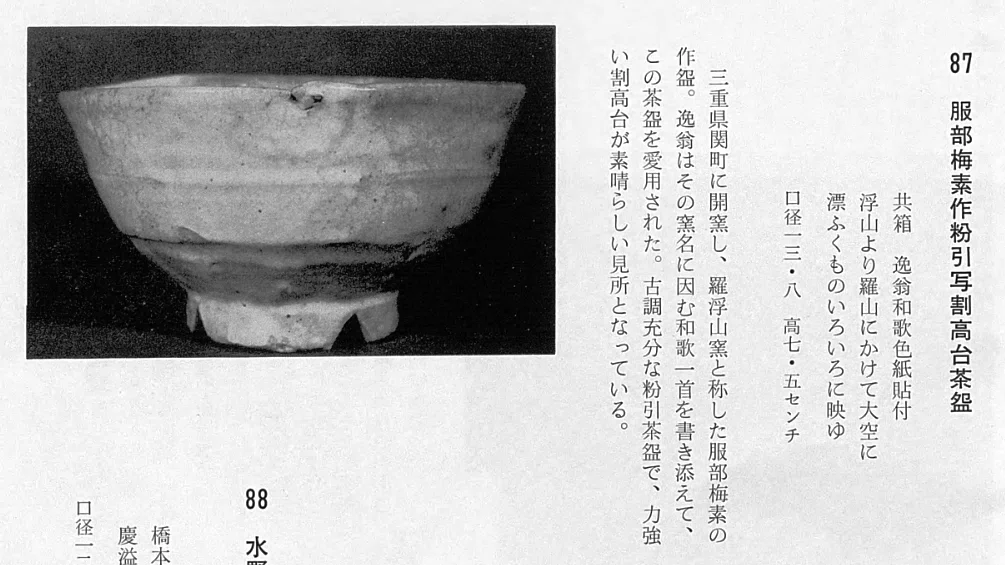
Judging from this text, it is possible that Kobayashi himself owned Hattori’s works. My reading was correct. As far as I have confirmed with the materials at hand, Hattori’s tea bowl was included in the catalog “Itsuo Collection: 100 Modern Tea Bowls” for the “100 Selected Modern Tea Bowls Exhibition” held at the Itsuo Art Museum in 1979. That tea bowl is the “Baiso Hattori-made Kohiki-utsushi Wari-kodai Tea Bowl.” It seems that Kobayashi cherished this tea bowl, adding a waka poem related to the kiln name to the label attached to the box: “Floating clouds drifting in the vast sky from Mt. Ro to Mt. Ra, shining in various ways.”――.
Incidentally, at the ‘First Exhibition’ held at Hankyu Department Store, Kaichi Tsuji of the long-established Kyoto kaiseki restaurant ‘Tsujito-me’ purchased a ‘Karatsu medium plate with a painting of wheat.’ Furthermore, from July 6 to 10 of the following year, 1949, a ‘Rafuzan Kiln Exhibition’ was held at Kuroda Toen in Ginza, Tokyo. Moreover, from September 22 to 28, 1950, a ‘Rafuzan Kiln Tea Bowl Recent Works Exhibition’ was held again at Hankyu Department Store, and an advertisement article from that time states, ‘Tea bowls from the Rafuzan Kiln have gained a reputation in the Tokyo area and are being praised as “new bowls for drinking tea.”‘
As I wrote in the previously mentioned past article, the tea room ‘Soan’ built by Hattori at a certain temple in Kamakura is now completely unused, and the plaque by Yasuzaemon Matsunaga has also decayed. In fact, I recently received a message from someone who said they read that article, and it was revealed that there are other tea rooms built by Hattori. Since there seem to be many items associated with Hattori there as well, I plan to visit and investigate soon.
At present, the modern and contemporary tea enthusiasts discussed as having interacted with Kobayashi are limited to figures with a certain established reputation, such as Hatakeyama, Matsunaga, and Goto. I dream of a day when Honan Tayama and Michikazu Hattori will be spoken of as modern and contemporary tea enthusiasts who interacted with Kobayashi, but perhaps these things are most enjoyable while one is still dreaming.
※
► Main Bibliography
‘Special Exhibition: Itsuo Art Museum Masterpiece Exhibition’ (Suntory Museum of Art, 1974)
‘Itsuo Art Museum Masterpiece Exhibition: Buson and Goshun’ (Suntory Museum of Art, 1981)
‘Itsuo Art Museum 40th Anniversary Exhibition: The Eye of Ichizo Kobayashi’ (Suntory Museum of Art, 1997)
‘Itsuo Art Museum Collection: Buson, Goshun, and Masterpieces of Tea Ceremony’ (Suntory Museum of Art, 2026)
Takeshi Hara, ‘History of Japanese Political Thought’ (Shinchosha, 2025)
‘The Universe of Koetsu Honami Exhibition’ (Tokyo National Museum, 2024)
Ichizo Kobayashi, ‘Daijo Sado-ki’ (Naniwa-sha, 1976)
‘Ninzaburo Takanashi: The World of Antique Art’ (Takanashi Academic Promotion Foundation, 2007)
‘Sado Geppo’ May 1940 issue (Sado Geppo-sha)
‘Nihon Bijutsu Kogei’ November 1948 issue (Nihon Bijutsu Kogei-sha)
‘Chawan’ July 1949 issue (Jitsun-sha)
‘Sado Geppo’ December 1949 issue (Sado Geppo-sha)
Jian Matsunaga, ‘My Tea Days and Evenings’ (Kawahara Shoten, 1950)
‘Nihon Bijutsu Kogei’ June 1951 issue (Nihon Bijutsu Kogei-sha)
‘Sado Geppo’ December 1951 issue (Sado Geppo-sha)
‘Nihon Bijutsu Kogei’ February 1952 issue (Nihon Bijutsu Kogei-sha)
‘Nihon Bijutsu Kogei’ March 1952 issue (Nihon Bijutsu Kogei-sha)
‘Sado Geppo’ October 1952 issue (Sado Geppo-sha)
Baiso Hattori, ‘On Tea Containers’ (Chisoku-kai, 1954)
‘Sado Geppo’ November 1955 issue (Sado Geppo-sha)
‘Sado Geppo’ February 1956 issue (Sado Geppo-sha)
‘Sado Geppo’ June 1956 issue (Sado Geppo-sha)
Sanmi Sasaki, ‘Fifty Years of the Way of Tea’ (Tankosha, 1970)
Mirei Shigemori, ‘Encyclopedia of Tea Rooms and Tea Gardens’ (Seibundo Shinkosha, 1973)
‘Introduction to Antique Shops’ (Kogei Shuppan, 1978)
‘100 Modern Tea Bowls: Itsuo Collection’ (Itsuo Art Museum, 1979)
‘Ichizo Kobayashi Diary’ Vol. 2, Vol. 3 (Hankyu Corporation, 1991)
‘People Shining in Great Kuwana’ (Association for the Compilation of the Same Book, 1937)
Kaichi Tsuji, ‘Two Years of Kaiseki Tea Gatherings’ (Kawahara Shoten, 1950)
‘Nihon Bijutsu Kogei’ September 1949 issue (Nihon Bijutsu Kogei-sha)
‘Nihon Bijutsu Kogei’ September 1950 issue (Nihon Bijutsu Kogei-sha)
Takahisa Omori
Born in Osaka in 1988. Writer and Representative of BUNBOU Co., Ltd. Primarily engaged in magazine reporting and writing, as well as book editing and writing. Alongside his main profession, he conducts collection and research related to Honan Tayama and modern tea enthusiasts.
